
Reviewed by Thomas Okafor, PhD · Last reviewed October 23, 2026 A friend sends you a link: “This peptide repairs torn tendons.” You click through to a blog, a forum, a podcast clip, each one more confident. Follow the trail long enough and it usually ends at one place: a journal paper, often from 2003 or earlier, describing an experiment in rats. Learning how to read a peptide study is mostly learning to make that trip yourself, and to notice what quietly fell away on the way to the headline. The good news is that you don’t need a lab coat. Four questions do most of the work:
- What type of study is it? Cells, animals or people.
- Who was studied, and how many? Species, group size and comparison group.
- What was measured? A tissue marker or an outcome a person would notice.
- Who paid, and has anyone repeated it? Funding, conflicts and independent replication.
The peptides discussed here are research compounds for laboratory use only and aren’t intended for human consumption. Please read our Medical Disclaimer.
The Evidence Ladder: From Cells to People
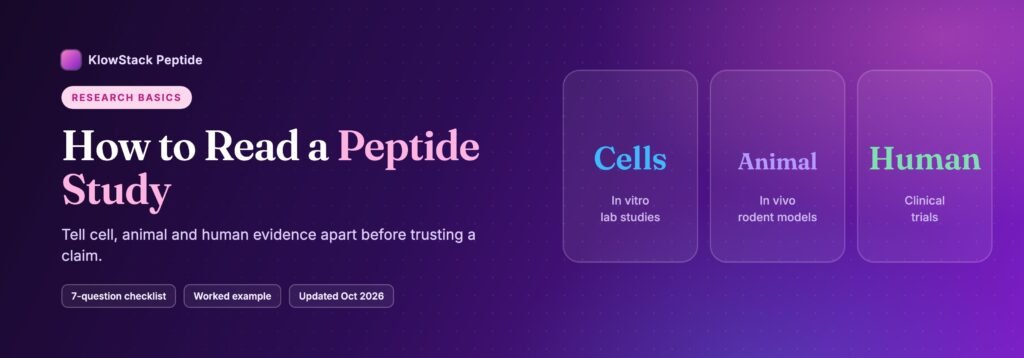
Scientific evidence comes in rungs. Cell studies form the bottom rung, then animal studies, case reports, observational studies, randomized controlled trials, and finally systematic reviews that pool many trials. Each rung answers a different question, and a claim is only as strong as the highest rung it has reached.
| Rung | What it is | What it can tell you | What it can’t |
|---|---|---|---|
| — | — | — | — |
| 🧪 Cell (in vitro) | Cells in a dish | Whether a mechanism is plausible | What happens in a living animal |
| 🐭 Animal (in vivo) | Usually rats or mice | Effects in a whole organism | Whether people respond the same way |
| 👤 Case report or series | A few people, no control group | That something was observed | Whether the peptide caused it |
| 👤 Observational | People followed over time | Patterns and associations | Cause and effect |
| 👤 Randomized controlled trial | People randomly assigned to peptide or placebo | Whether the peptide made the difference | Rare or long-term effects in small trials |
| 📚 Systematic review | Many studies pooled with set rules | The overall weight of evidence | Anything the underlying studies missed |
Approved peptide medicines such as semaglutide reached the top rungs because they went through phased human trials. The FDA describes Phase 3 alone as involving 300 to 3,000 volunteers over one to four years. Most research peptides discussed online still have their evidence on the bottom two rungs. New to the topic? Our explainer on what peptides are covers the basics first.
Step 1: Find Out What Kind of Study It Is
Start with the abstract, the short summary at the top of every paper. The study type is often announced in the first or last sentence, and certain words give it away:
- “In vitro,” “cell line,” “cultured cells” point to a lab dish.
- “Rats,” “mice,” “murine,” “in vivo” point to animals.
- “Randomized,” “placebo-controlled,” “double-blind” point to a human trial.
- “Retrospective,” “case series,” “chart review” point to people looked at after the fact, with no comparison group.
If the abstract is vague, the Methods section names the species, the subject count and the groups. PubMed, the free National Library of Medicine database, helps here too. Its filters let you narrow results by article type, such as Clinical Trial or Review, and by species, with “Humans” and “Other Animals” as the two options. Press releases and blog posts often drop the word “mice” from the headline, so if a summary never names a species, assume the original did.
Why Animal Results Often Don’t Carry Over to Humans
Animal research is how scientists decide which ideas deserve a human trial at all. But the step from rat to person trips up even well-funded drug programs. When researchers Daniel Hackam and Donald Redelmeier traced 76 highly cited animal studies, published in JAMA in 2006, they found that only about 37% were later replicated in human randomized trials, 18% were contradicted, and many were never tested in people. The FDA puts the reason plainly: preclinical research “is not a substitute for studies of ways the drug will interact with the human body.”
Species Differences
Rats and people break down compounds at different speeds, carry different versions of many receptors, and age on very different timelines. Injury models also differ. A lab can cut every rat’s tendon at exactly the same spot, in animals of the same age and strain. Human injuries arrive in endless variety, layered on age, health history and genetics.
Dose and Route Don’t Scale Simply
Animal doses are usually reported per kilogram of body weight, and it’s tempting to read those numbers straight across to people. Scientists don’t, because metabolism doesn’t scale in a straight line with size. The route can vary too. Many rodent studies inject compounds into the abdominal cavity, a route rarely used in human medicine. Any paper’s dose figures describe that experiment and nothing more.
Publication Bias and Small Labs
Positive results get published more readily than null ones, so the visible literature can lean optimistic. Authorship counts too. BPC-157 is a clear 🐭 animal example: most of its published research comes from one research group in Zagreb, Croatia. A 2025 systematic review in HSS Journal found that 35 of 36 BPC-157 studies it included were preclinical. A deep body of work from one team is a real asset, and independent groups repeating it is the natural next step.
Step 2: Check Who or What Was Studied, and How Many
Once you know the rung, look at the people or animals on it. Four details tell you a lot:
- Sample size. Small groups can produce big-looking effects by chance.
- Duration. Two weeks of observation can’t speak to two years.
- Control group. Without one, you can’t tell the peptide from time passing.
- Blinding. If researchers knew which group got what, expectations can color the scoring.
Size comparisons can be striking. BPC-157 has dozens of 🐭 rat studies behind it. On the 👤 human side, the published work we found is three small pilots from one clinic: a retrospective knee report of 17 people, an interstitial cystitis pilot of 12, and an intravenous tolerance pilot of 2. None had a placebo group. A 2026 review in Pharmaceutics counted fewer than 30 human subjects in total.
Step 3: Look at What Was Measured
The outcome a study measures is its endpoint. Some endpoints are tissue measurements, such as collagen under a microscope or a blood marker. Others are outcomes a person would notice, like walking without pain. The first kind are surrogate endpoints: stand-ins that may or may not track what people care about. Three statistical terms show up in nearly every results section:
- P-value. Roughly, how surprising the result would be if the peptide did nothing. Below 0.05 is the common cutoff for “statistically significant.”
- Confidence interval. The range where the true effect probably falls. A wide range means the estimate is shaky.
- Effect size. How big the difference was. Often skipped, and often the most telling.
“Statistically significant” means a result probably isn’t chance. It says nothing about size.
Step 4: Read the Conclusion Against the Data
An abstract’s final sentence tends to reach furthest. Words like “may,” “promising” and “potential” signal a hope for future research, a normal part of science. To see what the data support, check the Results section, with its numbers and tables, and the limitations paragraph near the end of the Discussion, where authors list what their design couldn’t answer. If the headline you started with says “repairs,” and the results describe better collagen organization in rats at day 14, you now know exactly how far the claim traveled.
Step 5: Check Funding, Conflicts and Replication
Funding and conflict-of-interest statements usually appear just before the references. They show who paid and whether any author holds a patent or company role tied to the compound. Industry funding is common and simply adds context. Replication is the bigger question. Has an unrelated group, with other equipment, found the same thing? One result is a lead. The same result from three independent teams starts to look like a pattern. Finally, check whether the paper still stands. PubMed labels retracted articles on their records, and Retraction Watch tracks retractions across journals.
A 7-Question Checklist for Any Peptide Claim
Most online claims stall at question one, because the study type was never mentioned. So the first job is always the same: go find the original paper.
Worked Example: Reading One Peptide Paper
Let’s run the checklist on a paper that shows up constantly in tendon discussions: Staresinic and colleagues, “Gastric pentadecapeptide BPC 157 accelerates healing of transected rat Achilles tendon,” published in the Journal of Orthopaedic Research in 2003.
- Study type. 🐭 Animal, plus a 🧪 cell experiment on cultured tendon cells. The title says “rat,” which is a gift.
- Species. Rats with a surgically cut Achilles tendon.
- How many, how long. Assessments ran on days 1, 4, 7, 10 and 14. The abstract doesn’t state group sizes, so the Methods section is where you’d confirm them.
- Compared with what. A saline control group.
- What was measured. Load to failure and tendon stiffness, a walking-function score, microscopic collagen and fibroblast formation, and the size of the tendon defect.
- Who paid. The authors are based in Zagreb, the same group behind most BPC-157 research; the funding statement appears in the full text.
- Replicated? Other rat studies followed, many from the same team. No human tendon trial has been published.
The authors reported improvement across every measure in rats: a carefully measured animal result and a starting point for human research. Evidence about people would need a human trial.
Which Peptides Have Human Trial Data?
The answer depends on which side of the approval line a peptide falls. Approved peptide medicines, including semaglutide, insulin and other prescription drugs, went through every phase of human trials, often with thousands of participants. Most research peptides discussed online have little or none. BPC-157 has the three small pilots described above. TB-500 and KPV have no published human trials that we found; KPV’s work is 🧪 cell and 🐭 mouse research. GHK-Cu has human cosmetic studies on skin, and no published trials of injected use. On the regulatory side, the FDA’s page on bulk drug substances that may present significant safety risks, current as of April 22, 2026, names BPC-157 and KPV among substances nominated for compounding that it evaluated. None of these research peptides is an FDA-approved drug. Our research guide tracks the evidence peptide by peptide, and our explainer What Is a Peptide Stack? covers the even thinner data on combinations.
FAQs
What is the difference between in vitro and in vivo?
In vitro means “in glass”: experiments on cells or tissue in a dish or tube. In vivo means “in the living,” a whole organism, usually a rat or mouse in peptide research. In vivo results carry more weight, yet neither describes people.
Does one study prove anything?
Science builds confidence through repetition: other teams, other methods, larger groups. A single well-run randomized trial in people can be highly informative, while a single rat study is best read as a reason to keep looking.
Why do so many peptide studies use rats?
Rats are affordable, well understood, and easy to study under tightly controlled conditions, with standardized injury models that labs can compare. Human trials need regulatory approval and years of funding, so early research almost always starts in rodents.
Where can I find the original study behind a claim?
Search the peptide name and key term on PubMed, which is free. A DOI or PubMed ID number in a blog’s citation leads straight to the paper. A claim with no citation at all tells you something too.
What does “peer reviewed” guarantee?
Peer review means other scientists read the paper before publication and judged its methods reasonable, a valuable quality filter. It doesn’t mean anyone repeated the experiment, and it doesn’t turn an animal result into a human one. Reading a peptide sequence, the string of amino acid letters, is a separate skill with its own guides.
Summary and Disclaimer
Every peptide claim has a rung on the evidence ladder, and the seven questions above will tell you which one in a few minutes. Cells and rats are where research begins, and people are where it has to end before a claim about humans can stand. For more beginner guides, visit our New to Peptides hub.
Sources
- [Research letter] Hackam DG, Redelmeier DA. 2006. Translation of research evidence from animals to humans. JAMA. doi:10.1001/jama.296.14.1731
- [Animal + lab] Staresinic M, et al. 2003. Gastric pentadecapeptide BPC 157 accelerates healing of transected rat Achilles tendon and in vitro stimulates tendocytes growth. Journal of Orthopaedic Research. doi:10.1016/S0736-0266(03)00110-4
- [Regulatory] Step 3: Clinical Research, FDA, content current as of January 4, 2018
- [Reference] PubMed User Guide, National Library of Medicine, accessed October 23, 2026
- [Systematic review] Vasireddi N, et al. 2025. Emerging use of BPC-157 in orthopaedic sports medicine: a systematic review. HSS Journal. doi:10.1177/15563316251355551
- [Review] Mateescu DM, et al. 2026. BPC-157 as an investigational peptide therapeutic. Pharmaceutics. doi:10.3390/pharmaceutics18050625
- [Human, retrospective] Lee E, Padgett B. 2021. Intra-articular injection of BPC 157 for multiple types of knee pain. Alternative Therapies in Health and Medicine. PubMed
- [Human pilot] Lee E, et al. 2024. Effect of BPC-157 on symptoms in patients with interstitial cystitis: a pilot study. Alternative Therapies in Health and Medicine. PubMed
- [Human pilot] Lee E, Burgess K. 2025. Safety of intravenous infusion of BPC157 in humans: a pilot study. Alternative Therapies in Health and Medicine. PubMed
- [In vitro + animal] Dalmasso G, et al. 2008. PepT1-mediated tripeptide KPV uptake reduces intestinal inflammation. Gastroenterology. PMC2431115
- [Regulatory] Certain Bulk Drug Substances for Use in Compounding that May Present Significant Safety Risks, FDA, current as of April 22, 2026
- [Reference] Retraction Watch, The Center for Scientific Integrity, accessed October 23, 2026