
Reviewed by Thomas Okafor, Peptide Chemist · Updated October 2026
What are peptides, and why do they suddenly show up everywhere? They’re on the front of serum bottles at the drugstore, in every news story about Ozempic, and all over research forums. Same word, very different products, and it’s easy to come away more confused than when you started.
The good news is that the core idea is simple. Peptides are small molecules built from the same pieces as proteins, and many of them work as chemical messengers. Once you see how they’re put together, the skincare labels, the GLP-1 headlines and the research compounds all start to make sense.
This guide explains peptides without the jargon: what they are, how they compare with proteins, how they work, how they’re made, and where the different kinds fit legally.
What Are Peptides?
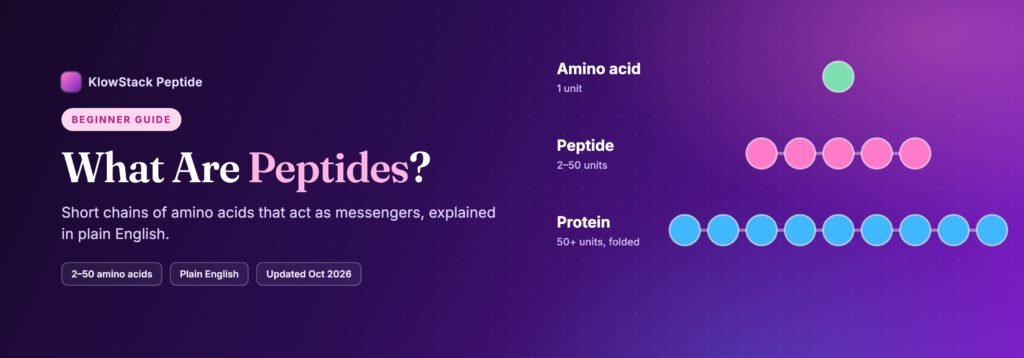
Peptides are short chains of amino acids linked by peptide bonds, usually between 2 and 50 amino acids long. Many act as biological messengers, carrying signals between cells. Insulin, oxytocin and GLP-1 are well-known natural examples, and scientists also make peptides in the lab for medicines and research.
Here’s an analogy that sticks. Amino acids are the letters. Peptides are words, short strings of letters with a specific meaning. Proteins are full sentences, long chains that fold into complex shapes. Change one letter and you can change the word’s meaning entirely, and the same is true for peptides: swapping a single amino acid can change what a peptide does.
A peptide bond forms when the acid end of one amino acid links to the amino end of the next, releasing a molecule of water. Chemists call that a condensation reaction. It also gives every peptide a direction, from its N-terminus (the start of the chain) to its C-terminus (the end), so the same letters in reverse order spell a different peptide.
There are 20 standard amino acids, so the number of possible combinations is enormous. A chain of just five amino acids can be built 3.2 million different ways.
Amino Acids vs Peptides vs Proteins
Amino acids are the single building blocks. Peptides are short chains of them, typically 2 to 50 units. Proteins are longer chains, usually more than 50 amino acids, that fold into stable three-dimensional shapes. The cutoff is a convention, so you’ll see slightly different numbers in different textbooks.
| Size | Examples | Main role | |
|---|---|---|---|
| Amino acid | 1 unit | Glycine, lysine, histidine | Building blocks; some act alone as signals |
| Peptide | About 2 to 50 units | Oxytocin (9), GLP-1 (30 to 31), GHK (3) | Messengers, hormones, signals |
| Protein | Usually 50+ units | Collagen, hemoglobin, antibodies | Structure, transport, enzymes, defense |
Insulin is the classic borderline case. It has 51 amino acids across two linked chains, so some sources call it a peptide hormone and others a small protein. Both labels are fair.
Dipeptides, oligopeptides and polypeptides
Chemists also name peptides by length. A dipeptide has two amino acids, like carnosine, found in muscle. A tripeptide has three, like GHK or glutathione. Oligopeptides are short chains, usually up to about 20 amino acids. Polypeptides are longer chains, and once a polypeptide folds into a working structure, it’s usually called a protein.
How Do Peptides Work in the Body?
Most signaling peptides work by binding to receptors on the surface of cells. Each receptor fits a specific peptide shape, a bit like a lock and key. When the right peptide binds, it triggers a chain of events inside the cell, such as releasing a hormone or switching certain genes on or off.
Peptides as messengers: the lock-and-key idea
Picture a hotel key card. Each card opens one door, and the door doesn’t care who’s holding the card, only that it fits. A peptide hormone travels through the blood until it meets cells carrying its matching receptor. Binding sends a signal through the cell membrane without the peptide ever entering the cell. Insulin binding to its receptor, for example, tells muscle and fat cells to take glucose out of the blood. The precision is the point. Because a peptide fits only certain receptors, it tends to produce a focused effect.
Why peptides don’t last long in the body
Natural peptides are built to be temporary. Enzymes called peptidases chop them up quickly, so the signal switches off once it’s delivered. Native GLP-1, for instance, has a half-life of under two minutes in the bloodstream, according to a review in Physiological Reviews. That speed is useful for the body and a headache for drug developers, which is why scientists modify peptides to resist breakdown. Semaglutide, a modified GLP-1 molecule, has a half-life of about one week, per its FDA prescribing information. The same fragility shapes how researchers study peptides in cells and animals.
Common Peptides You’ve Already Heard Of
Some of the best-known peptides are insulin, which regulates blood sugar; oxytocin, which drives labor and bonding; GLP-1, a gut hormone behind a major class of diabetes and weight drugs; glutathione, an antioxidant; collagen peptides, sold as supplements; and GHK-Cu, a copper-binding peptide studied in skin research.
| Peptide | Length | Natural role | One line on it |
|---|---|---|---|
| Insulin | 51 amino acids | Lowers blood sugar | The first peptide hormone used as a medicine, in 1922 |
| Oxytocin | 9 | Triggers labor contractions and milk release | Often called the “bonding hormone” |
| GLP-1 | 30 to 31 | Released by the gut after eating | The template for semaglutide and related drugs |
| Glutathione | 3 | Protects cells from oxidative damage | Made by nearly every cell |
| Collagen peptides | Varies | Fragments of collagen protein | Made by breaking down collagen from animal sources |
| GHK-Cu | 3, plus copper | Found in blood plasma | Widely studied in skin research. See our GHK-Cu guide |
Notice how different these are. Two of them are hormones, one is an antioxidant, one is a food product and one is a research compound. “Peptide” describes the structure, and says nothing about safety, quality or what a product does.
How Peptides Are Made
Peptides are made in two main ways. Living things build them naturally from genetic instructions. In labs, most peptides are made by solid-phase synthesis, which attaches amino acids one at a time to a tiny resin bead. Some, like modern insulin, are produced by engineered microbes.
Solid-phase synthesis was invented by chemist Bruce Merrifield, who won the 1984 Nobel Prize in Chemistry for it. Think of it as stringing beads on a thread anchored to a table. Each amino acid is added, the excess is washed away, and the cycle repeats until the chain is complete. Then the finished peptide is cut free from the bead.
No chemical step works perfectly every time. Each cycle can leave behind a few chains that are missing an amino acid or carry a leftover protective group, and those mistakes add up in longer peptides. That’s why purification and testing are part of the process. Our guide on how to verify a peptide COA explains how labs confirm what’s in a batch.
Where Peptides Are Used Today
Peptides show up in three main places today: approved medicines, cosmetic products and laboratory research. Each operates under different rules and quality standards, which is why the same word can describe a prescription drug, a face cream and a research chemical.
Approved peptide medicines
More than 80 peptide drugs have reached the market worldwide, according to a 2021 review in Nature Reviews Drug Discovery. They include insulin, GLP-1 drugs like semaglutide, and oxytocin used in hospitals during childbirth. Drug developers like peptides because they’re highly selective. Most still have to be injected, since digestive enzymes break them down in the stomach. Oral semaglutide (Rybelsus) is a notable exception, made possible by an ingredient that helps it get absorbed.
Skincare and cosmetics
Cosmetic peptides such as palmitoyl pentapeptide-4 (sold as Matrixyl) and copper peptides appear in serums and creams. In the US, cosmetics don’t need FDA approval before sale, and they can’t legally claim to treat conditions. Their claims describe appearance, and the research behind most cosmetic peptides is a handful of small studies, often funded by the ingredient’s maker.
Research compounds
Many peptides are studied in cells and animals long before any human trial, if one ever happens. These are sold as research-use-only chemicals for labs. Scientists use them to probe how signaling pathways work, and those results help decide which molecules, if any, move on to clinical trials. Our research guide covers how that research is organized.
Are Peptides the Same as Ozempic or Steroids?
Ozempic (semaglutide) is a peptide drug, but most peptides have nothing to do with GLP-1 or weight. Steroids are a different family of molecules altogether. They’re built from a four-ring carbon structure, while peptides are chains of amino acids.
Peptides vs GLP-1 drugs like Ozempic
Semaglutide is a modified version of the natural GLP-1 peptide, with tweaks that let it last for days. So yes, Ozempic is considered a peptide. That doesn’t mean other peptides act like it. A GLP-1 drug targets GLP-1 receptors, and a peptide that binds different receptors produces different effects.
Peptides vs steroids
Steroids, including testosterone and cortisol, are built from cholesterol and share a fused four-ring shape. Being fat-soluble, they slip through cell membranes and act on receptors inside the cell, often changing gene activity directly. Peptides are usually water-soluble and act on receptors at the cell surface. The two groups differ in structure, in where they act and in how they’re regulated.
Are Peptides Safe and Legal? Understanding Their Status
A peptide’s legal status depends on how it’s sold. FDA-approved peptide drugs have been reviewed for safety and effectiveness and need a prescription. Supplements and cosmetics are sold without pre-market approval. Research-use-only peptides are laboratory chemicals with no approval for human use.
| Type | FDA review before sale | How it’s sold | Example |
|---|---|---|---|
| Approved drug | Yes, clinical trials and approval | Prescription | Semaglutide, insulin |
| Supplement or cosmetic | No pre-market approval | Over the counter | Collagen peptides, peptide serums |
| Research use only | No | To labs, for research | BPC-157, KPV |
Supplements such as collagen peptides are regulated as foods under the Dietary Supplement Health and Education Act of 1994. Makers are responsible for their products’ safety and labeling, and the FDA steps in after problems appear.
For research peptides, the current state of the science is that much of it comes from cell and animal studies, and the safety picture in people hasn’t been established. Our guide to whether peptides are legal explains current US rules, including the 2026 changes, and our explainer on research use only covers what that label means.
What Is a Peptide Stack?
A peptide stack is a combination of two or more peptides studied together. In a stack, the peptides come in separate vials. In a blend, they’re premixed in one vial. Researchers look at combinations to see whether compounds that act on different pathways behave differently together.
KLOW is one well-known example, combining GHK-Cu, BPC-157, TB-500 and KPV. A stack also lets researchers vary each compound’s amount separately, which a premixed vial can’t do. Our guides to what a peptide stack is and the KLOW stack go deeper.
How to Read Peptide Research
Most findings on research peptides come from lab dishes (in vitro) and animal studies, mainly in mice and rats. Those results are useful for generating ideas, but they often don’t carry over to people, so the study type is the first thing to check.
Animal studies often use exposure times and outcomes that don’t match anything a human trial would test, and many compounds that look promising in mice never make it through clinical trials. Before trusting a headline, ask three questions: what model was used, how many subjects were studied, and who ran the study. Our guide on how to read a peptide study walks through it step by step.
Frequently Asked Questions
Are peptides natural?
Many are. The body makes thousands of peptides, including insulin, oxytocin and GLP-1. Others are synthetic, made in labs by solid-phase synthesis. Some synthetic peptides copy natural ones exactly, while others are modified versions designed to last longer.
Are peptides proteins?
Not quite. Peptides and proteins are both chains of amino acids, but peptides are shorter, usually 2 to 50 units. Proteins are longer chains that fold into stable 3D shapes. The boundary is a convention, so borderline molecules like insulin get called both.
Are peptides like steroids?
No. Steroids are fat-soluble molecules built from a four-ring carbon structure, and they act mostly inside cells. Peptides are chains of amino acids that usually act on receptors at the cell surface. They’re regulated differently, too.
Is Ozempic a peptide?
Yes. Ozempic’s active ingredient, semaglutide, is a modified version of the GLP-1 peptide. Its changes help it resist breakdown, giving it a half-life of about a week. Most other peptides work through entirely different receptors.
Are collagen peptides the same as research peptides?
No. Collagen peptides are fragments of collagen protein sold as food supplements. Research peptides are specific synthetic sequences, such as BPC-157, sold for laboratory use only. They differ in structure, purpose and regulation.
Conclusion
Peptides are short amino acid chains, and many of them act as precise chemical messengers. The same word covers prescription drugs, supplements, skincare and research chemicals, each with its own rules. Once you know what a peptide is, the next step is learning how the research compounds compare. Start with our guide for people new to peptides.
Sources
- Holst JJ. 2007. The physiology of glucagon-like peptide 1. Physiological Reviews. doi:10.1152/physrev.00034.2006
- Muttenthaler M, King GF, Adams DJ, Alewood PF. 2021. Trends in peptide drug discovery. Nature Reviews Drug Discovery. doi:10.1038/s41573-020-00135-8
- Ozempic (semaglutide) prescribing information, US Food and Drug Administration
- The Nobel Prize in Chemistry 1984: Bruce Merrifield, NobelPrize.org