
Regulatory Watch · Reviewed by Thomas Okafor, PhD · Published October 31, 2026
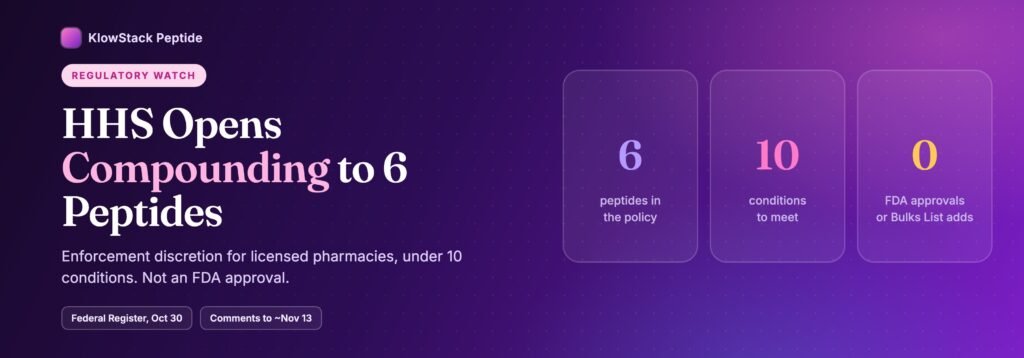
The policy we’ve followed since it reached the White House on October 14 is now public. HHS issued its “Enforcement Discretion Policy Regarding 503A Compounding Using Certain Peptide Bulk Drug Substances” on October 28, and the Federal Register published a notice of its availability on October 30 [1]. For the first time, a licensed pharmacist with a prescription in hand has a federal green light, under conditions, to prepare products containing these six peptides.
What the policy does
According to the notice, HHS “does not intend to take enforcement action against a State-licensed pharmacy, Federal facility, or licensed physician compounding a drug product using a peptide bulk drug substance” listed in its appendix [1]. The covered peptides are:
The policy stays in place while FDA develops the 503A Bulks List through formal rulemaking, and the notice says FDA’s future rules “may propose adding some or all of these peptides” to that list [1].
The 10 conditions
A summary by health care attorneys at Foley & Lardner lists the conditions a compounded product must meet [2]:
| \\\# | Condition |
|---|---|
| 1 | The peptide is one of the six in the policy’s appendix |
| 2 | It matches the identity and limited route of administration set in the appendix |
| 3 | The bulk substance comes from an FDA-registered facility with a valid certificate of analysis |
| 4 | The original manufacturer is FDA-registered and follows current good manufacturing practice |
| 5 | Serious adverse events are reported to FDA’s MedWatch program |
| 6 | Labels state “This is a compounded drug product. Not for resale.” |
| 7 | The product contains only one active ingredient |
| 8 | Oral products have documentation of adequate bioavailability in humans |
| 9 | Any included delivery device is an FDA 510(k)-cleared syringe |
| 10 | Compounding follows all other applicable provisions of federal drug law |
Condition 3 puts quality documents at the center. A valid certificate of analysis becomes a requirement for the raw material itself; what those documents contain is laid out in our peptide COA guide. Condition 7 also means multi-peptide blends fall outside the policy.
What it doesn’t do
The policy is limited in several ways [1][2]:
- No approval. It “does not constitute FDA approval of the compounded products.”
- No Bulks List change. The peptides aren’t added to the 503A Bulks List.
- Revisable. HHS “may revisit application of this interim policy” if a safety signal or quality problem arises [1].
- Draft status. The Federal Register notice describes it as a draft policy, with written comments accepted for two weeks after publication, through about November 13, 2026, on Docket No. HHS-OASH-2026-0496 [1][2].
Where research-use-only peptides fit
The policy covers compounding by pharmacies, federal facilities and physicians under section 503A. Research-use-only products are a different channel. HHS presented the policy partly as a way to move demand away from that market, saying it aims to “discourage the continued, widespread use of certain research-use-only peptides supplied by foreign manufacturers” [2][3]. Nothing in the notice changes how research-use-only materials are classified.
How we got here
| Date | Step |
|---|---|
| April 2026 | BPC-157, TB-500, KPV and others left FDA’s Category 2 list after nominations were withdrawn |
| July 23 and 24, 2026 | FDA’s advisory committee voted on seven peptides, recommending six |
| October 14, 2026 | HHS and FDA sent the interim policy to the White House budget office |
| October 20, 2026 | Kennedy called for a regulated peptide market |
| October 28, 2026 | HHS issued the enforcement discretion policy |
| October 30, 2026 | Federal Register notice published; two-week comment period opened |
Reaction divided along familiar lines. Supporters describe the policy as expanding patient access through licensed pharmacies, while consumer advocates, including Public Citizen, argue every peptide should go through the standard FDA approval process for new drugs [3]. Our earlier coverage of the policy’s White House review, Kennedy’s “regulated market” remarks, and the July advisory vote gives the background.
What to watch next
- The comment period, closing around November 13, and any revisions that follow.
- FDA rulemaking on the 503A Bulks List, which would make any listing permanent.
- The next advisory committee meeting, expected by February 2027.
For how these peptides are classified more broadly, see our page on whether peptides are legal. This article reports on a federal policy and isn’t legal or medical advice.
Sources
- Department of Health and Human Services. “Enforcement Discretion Policy Regarding 503A Compounding Using Certain Peptide Bulk Drug Substances,” notice of availability, Docket No. HHS-OASH-2026-0496, Federal Register document 2026-22192, published October 30, 2026. https://www.federalregister.gov/d/2026-22192
- Holtz WE, Beaver NA, Rosen DL. “Peptides: HHS Announces Limited Enforcement Discretion for Compounding of Six Peptides,” Foley & Lardner via National Law Review, October 30, 2026. https://natlawreview.com/article/peptides-hhs-announces-limited-enforcement-discretion-compounding-six-peptides
- Eglovitch JS. “HHS will permit compounding of six peptides ahead of formal rulemaking,” RAPS Regulatory Focus, October 29, 2026. https://www.raps.org/resource/hhs-will-permit-compounding-of-six-peptides-ahead-of-formal-rulemaking.html