Reviewed by Thomas Okafor, PhD · Last reviewed October 24, 2026
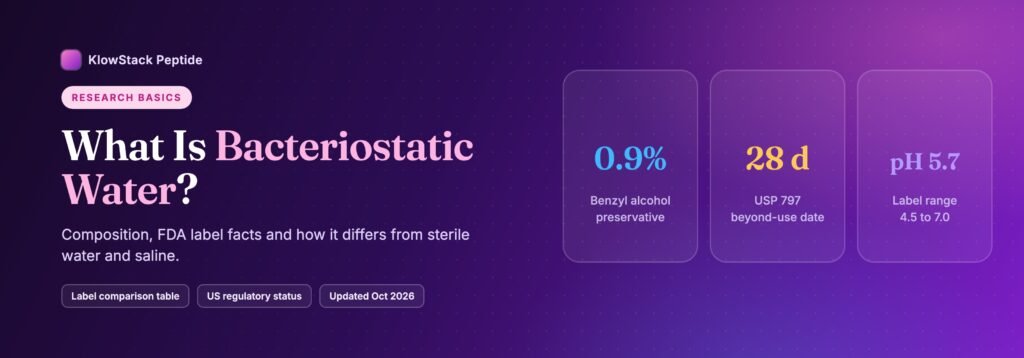
Bacteriostatic water is sterile water for injection with a small amount of benzyl alcohol added as a preservative, 0.9% (9 mg per mL) on the most common US label. The preservative keeps bacteria from multiplying, so the vial can be entered more than once. Sterile water without a preservative is meant for single use. This page explains what the product is and what its label says. It doesn’t explain how to use it on people. Everything discussed on KlowStack is for research use only and isn’t for human consumption; our Medical Disclaimer has the full statement.
What Bacteriostatic Water Is
Composition and USP labeling
The current DailyMed label for Bacteriostatic Water for Injection, USP describes it as “a sterile, nonpyrogenic preparation of water for injection containing 0.9% (9 mg/mL) or 1.1% (11 mg/mL) of benzyl alcohol added as a bacteriostatic preservative.” Nonpyrogenic means it’s tested to be free of fever-causing substances such as bacterial endotoxins. The label lists a pH of 5.7, within a range of 4.5 to 7.0, and storage at controlled room temperature, 20 to 25 °C (68 to 77 °F). It comes in multiple-dose vials, commonly in the tens of milliliters. “USP” signals that the product meets the standards of the United States Pharmacopeia, the body that sets quality benchmarks for medicines sold in the US.
What “bacteriostatic” means
Microbiologists separate two effects. Bactericidal agents kill bacteria. Bacteriostatic agents stop them from growing and dividing. Benzyl alcohol at preservative strength belongs in the second camp: its job is to keep any stray organism introduced during repeated access from building into a contamination problem. How do manufacturers know the preservative does its job? Preserved multiple-dose products are evaluated with USP’s antimicrobial effectiveness testing, General Chapter 51, in which the product is deliberately challenged with set microbes and checked over several weeks to confirm their numbers fall or stay controlled. That testing window is one reason opened-vial limits exist at all. That distinction carries a practical limit. Bacteriostatic water doesn’t sterilize anything. If a vial or a sample is already contaminated, the preservative won’t reverse it.
Bacteriostatic Water vs Sterile Water vs Saline
These four products look identical in the vial, and their labels are what tell them apart. The table draws on current DailyMed labels.
| Product | Preservative | Vial type | Label-listed purpose | Key label caution |
|---|---|---|---|---|
| — | — | — | — | — |
| Sterile Water for Injection | None | Single-dose | Diluting or dissolving drugs for injection | Make approximately isotonic before intravenous use |
| Bacteriostatic Water for Injection | Benzyl alcohol 0.9% or 1.1% | Multiple-dose | Diluting or dissolving drugs for injection | Not for use in neonates; not for fluid replacement |
| 0.9% Sodium Chloride (preservative-free) | None | Usually single-dose | Diluent; named on the bacteriostatic saline label for catheter flushing | The version labels point to where benzyl alcohol must be avoided |
| Bacteriostatic 0.9% Sodium Chloride | Benzyl alcohol 0.9% | Multiple-dose | Diluting or dissolving drugs for injection | Not for use in neonates; not for flushing catheters |
The key differences come down to two questions. Is there a preservative? And is there salt? Sterile water has neither, which makes it hypotonic. The bacteriostatic saline label describes that product as isotonic, matching the salt balance of body fluids, because it contains 9 mg of sodium chloride per mL. The water-only label carries a caution that the saline version doesn’t need: water given intravenously without a dissolved solute “may result in hemolysis,” the bursting of red blood cells.
How Benzyl Alcohol Works as a Preservative
Benzyl alcohol is a simple aromatic alcohol, a benzene ring attached to a CH₂OH group. It occurs naturally in many plants and is widely used as a preservative in medicines and cosmetics. Its antimicrobial action is linked to how easily it slips into fatty membranes. A 1990 study in Research in Microbiology by Lucchini and colleagues tested phenolic compounds and aromatic alcohols against bacteria in the lab and found that all of them could damage bacterial membranes, especially in Gram-negative species, with potency tied to how fat-soluble each compound was. The authors also found evidence that benzyl alcohol has more specific mechanisms beyond membrane damage. This is 🧪 lab data on bacterial cultures. Benzyl alcohol is also mildly volatile and slowly breaks down to benzaldehyde and benzoic acid when exposed to air and light over long periods, which is part of why labels set storage conditions and expiration dates. Concentration decides the effect. At the low level used in multiple-dose vials, the goal is growth control over the life of an opened vial. That steady background protection is what makes repeated entries possible, and it’s why the preservative’s performance is tested over a defined period, discussed below.
Bacteriostatic Water in Research Labs
In laboratories, bacteriostatic water is one of several diluents available for returning freeze-dried compounds to solution in vitro. Its appeal is convenience: a preserved vial can be accessed repeatedly over days. Its limits come from the same preservative that makes it convenient. Benzyl alcohol can change how some proteins behave in solution. Two well-known lab studies show the effect:
- Interferon-gamma (🧪 lab). Lam and colleagues reported in Pharmaceutical Research in 1997 that adding 0.9% benzyl alcohol to recombinant interferon-gamma formulations changed the protein’s tertiary structure and produced high molecular weight aggregates.
- Interleukin-1 receptor antagonist (🧪 lab). Roy and colleagues at the University of Colorado reported in 2005 that reconstituting this freeze-dried protein with 0.9% benzyl alcohol “caused a greater degree of protein aggregation than reconstitution with water.” They also found that good stabilizers during freeze-drying reduced the effect.
Those studies used large proteins. For short peptides they flag a possibility for each lab to test in its own system. Many peptides also need slightly acidic, basic or organic solvents to dissolve at all, and cell-based assays can be sensitive to preservatives. Our guide to peptide reconstitution compares solvent options, and our peptide storage guide covers how dissolved samples are kept.
FDA Label Warnings and US Regulatory Status
Bacteriostatic water is a drug product in the US, and its label sets out clear limits.
- Prescription status. The label is marked “Rx only,” meaning federal law restricts dispensing to a prescription.
- Neonates. The label’s boxed warning reads “NOT FOR USE IN NEONATES,” and its contraindications state that solutions containing benzyl alcohol “must not be used in this patient population.”
- Other listed limits. The label says products with benzyl alcohol shouldn’t be used for fluid replacement or in epidural or spinal anesthesia procedures.
The neonatal warning traces back to 1982. That June, CDC’s Morbidity and Mortality Weekly Report described 16 deaths among premature, low-birth-weight infants whose intravenous catheters had been flushed with bacteriostatic saline containing 9 mg/mL benzyl alcohol. The infants developed metabolic acidosis and gasping breathing, now known as “gasping syndrome.” The FDA urged hospitals to stop using these flushes in premature infants, and the report noted that similar deaths hadn’t recurred after preservative-free solutions were substituted. For broader context, see our pages on whether peptides are legal and FDA warning letters to research-use-only sellers. Our upcoming explainer, What does research use only mean, covers how that label works.
Shelf Life After Opening
An unopened vial follows the expiration date printed on it. Once a multiple-dose vial is punctured, healthcare standards set a beyond-use date. The widely cited figure is 28 days, from USP General Chapter 797 on sterile preparations, unless the manufacturer specifies otherwise. The Joint Commission explains the logic: manufacturers are required to test how well the bacteriostatic agent works over a 28-day period. It also notes that the vial should be labeled with its last usable date, since a “date opened” label alone doesn’t meet the intent. The product label itself specifies room-temperature storage and doesn’t list a separate opened-vial period. For blend-specific handling of research samples, see our KLOW storage guide.
Common Misconceptions
A few ideas about bacteriostatic water circulate online that its label and the chemistry don’t support:
- It “activates” peptides. It doesn’t. It’s a solvent. A peptide is chemically the same molecule dissolved in it or in plain sterile water.
- It makes a peptide more stable. The preservative controls microbes. It does nothing to slow hydrolysis, oxidation or deamidation, and for some proteins it can encourage aggregation.
- It rescues a contaminated vial. Bacteriostatic means growth-inhibiting. It won’t sterilize something already contaminated.
- More preservative means more protection. Concentration is set for a reason. The label figures, 0.9% or 1.1%, balance microbial control against the known toxicity of benzyl alcohol in vulnerable groups.
- It works for every compound. Labels for some approved drugs specify sterile water or a particular diluent, and lab work often calls for buffers or co-solvents.
FAQs
What is bacteriostatic water used for?
Its FDA label lists one purpose: diluting or dissolving drugs for injection, following the instructions of the drug’s manufacturer. In research labs it’s one of several diluents used to dissolve freeze-dried compounds for in vitro work.
What does the benzyl alcohol in bac water do?
It acts as a preservative. At 0.9%, benzyl alcohol inhibits bacterial growth so a multiple-dose vial can be entered more than once. Lab studies link its action to disruption of bacterial membranes.
How is bacteriostatic water regulated in the US?
It’s sold as a prescription drug product made to USP standards, with an FDA-format label listed on DailyMed. The label carries a boxed warning against use in neonates and lists other contraindications. Rules on dispensing can vary by state, so check current primary sources.
What is the difference between bacteriostatic water and sterile water?
The preservative. Sterile water for injection contains no bacteriostat and comes in single-dose containers. Bacteriostatic water contains benzyl alcohol and comes in multiple-dose vials.
How long can an opened vial be kept according to the label?
The label lists room-temperature storage and an expiration date, without a separate opened-vial period. USP Chapter 797 sets a 28-day beyond-use date for punctured multiple-dose containers unless the manufacturer states otherwise.
Research-Use Disclaimer and Sources
Bacteriostatic water is simple on paper: water plus a preservative. Its label, its history and its chemistry explain both why it’s useful for repeated access and why it isn’t the right solvent for everything.
Sources
- [Regulatory label] Bacteriostatic Water for Injection, USP, DailyMed, National Library of Medicine, label published July 8, 2026, accessed October 24, 2026
- [Regulatory label] Bacteriostatic 0.9% Sodium Chloride Injection, USP, DailyMed, label published April 6, 2026, accessed October 24, 2026
- [Regulatory label] Sterile Water for Injection, USP, DailyMed, accessed October 24, 2026
- [Public health report] Neonatal Deaths Associated With Use Of Benzyl Alcohol: United States, CDC, MMWR 31(22):290-1, June 11, 1982
- [Accreditation guidance] Managing Multi-dose Vials of Injectable Medication, The Joint Commission, accessed October 24, 2026
- [Lab] Lucchini JJ, Corre J, Cremieux A. 1990. Antibacterial activity of phenolic compounds and aromatic alcohols. Research in Microbiology. doi:10.1016/0923-2508(90)90075-2
- [Lab] Lam XM, Patapoff TW, Nguyen TH. 1997. The effect of benzyl alcohol on recombinant human interferon-gamma. Pharmaceutical Research. doi:10.1023/a:1012190120061
- [Lab] Roy S, Jung R, Kerwin BA, Randolph TW, Carpenter JF. 2005. Effects of benzyl alcohol on aggregation of recombinant human interleukin-1-receptor antagonist in reconstituted lyophilized formulations. Journal of Pharmaceutical Sciences. doi:10.1002/jps.20258