
Reviewed by Thomas Okafor, PhD · Last reviewed October 24, 2026
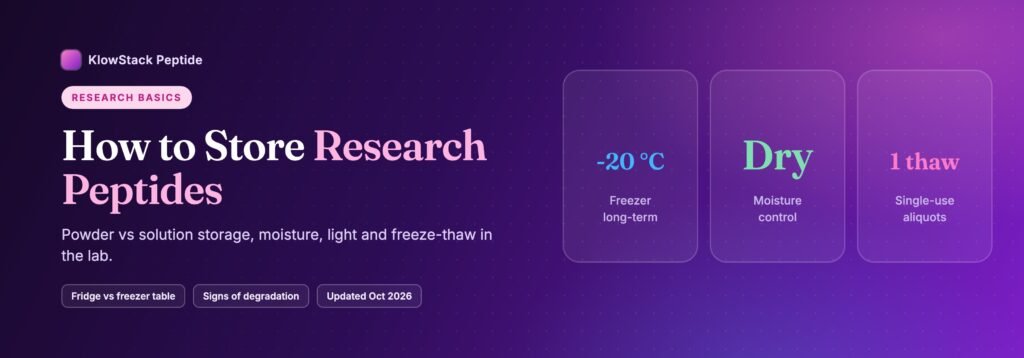
A vial comes out of the freezer, a researcher pops the cap right away, and within seconds a faint fog forms on the inside of the glass. Nothing looks wrong. But that fog is water, and the fluffy white powder at the bottom drinks it in. Weeks later, the sample tests a few points lower in purity, and nobody can say why. Knowing how to store research peptides comes down to small moments like this one. Peptide storage depends on five things: the form of the sample (dry powder or solution), temperature, moisture, light and oxygen. Freeze-dried powder kept cold, dry, dark and sealed holds up far longer than any solution. Solutions are the fragile stage, best divided into single-use portions and frozen.
This guide covers research samples handled in laboratory settings. Every compound mentioned is a research material for the lab, never for human consumption, as our Medical Disclaimer explains.
Why Peptides Degrade: The Chemistry
Peptides are chains of amino acids held together by amide bonds, and each link and side chain is a possible weak spot. A 2010 review in Pharmaceutical Research by Mark Manning and colleagues, a standard reference in protein formulation, groups the damage into chemical changes, where bonds break or form, and physical changes, where molecules unfold or clump. Peptides face the same two families of problems, and a 2014 review of peptide impurities from Ghent University adds peptide-specific routes such as succinimide and pyroglutamate formation to the list.
Hydrolysis and moisture
Water can break the peptide backbone apart, a reaction called hydrolysis. It’s slow in a dry solid and much faster in solution, which is the main reason freeze-dried powder outlasts any liquid form. Bonds next to aspartic acid are especially prone to it.
Oxidation (Met, Cys, Trp) and deamidation (Asn, Gln)
Oxygen attacks a few residues more readily than others. Methionine, cysteine and tryptophan oxidize, and free cysteines can pair up into unwanted disulfide links. Asparagine and glutamine can lose an amide group, a process called deamidation, which changes the peptide’s charge and sometimes its shape. Deamidation speeds up in neutral to basic solutions.
Aggregation, light and heat
Heat speeds up nearly every reaction above. It can also help peptides stick together into aggregates, which may cloud a solution or simply vanish from the main HPLC peak. Light, particularly UV, can damage tryptophan and other aromatic residues, which is why manufacturers recommend dark storage.
How to Store Lyophilized (Powder) Peptides
Lyophilization, or freeze-drying, removes water while the sample is frozen. The result is a dry, porous cake that slows hydrolysis to a crawl. It’s the form most research peptides ship in, and with good handling it’s the form that lasts longest.
Short-term vs long-term storage
Manufacturer handling guides agree on cold storage. GenScript’s guidelines say lyophilized peptides “should be stored at -20℃, away from bright light,” and note that most stay stable for several years under those conditions. JPT, another peptide manufacturer, gives a range of -20 °C to -80 °C. For brief periods, such as transit, dry powder tolerates higher temperatures far better than solutions, though suppliers tend to avoid promising exact timeframes, and we do too.
Moisture control and desiccants
Freeze-dried powder is hygroscopic: it pulls water from the air. JPT treats a desiccator, or a container with desiccant packs, as a core requirement for keeping powder stable. Tightly capped vials, minimal headspace and, for oxidation-prone sequences, an inert gas such as nitrogen or argon in the vial all reduce exposure. JPT recommends storing samples under vacuum or in an inert atmosphere before reconstitution.
Warming the sealed vial before opening
Here’s where the foggy vial from the opening comes in. A cold vial opened in a warm room acts like a glass of iced tea on a summer porch: moisture from the air condenses on every cold surface, including the powder. GenScript’s first handling step is to “warm the peptide vial to room temperature before opening.” Giving the sealed vial a short rest on the bench, and resealing it promptly, keeps that water out. For the lab chemistry of dissolving a sample, see our guide to peptide reconstitution.
How to Store Peptides in Solution
Once a peptide is dissolved, the clock speeds up. Water enables hydrolysis and deamidation, dissolved oxygen fuels oxidation, and microbes can grow. GenScript states plainly that it “does not recommend storing peptides in solution.”
Aliquoting and freeze-thaw cycles
When a solution must be kept, both GenScript and JPT advise dividing it into smaller aliquots and freezing them, so each portion thaws only once. JPT’s guidance puts dissolved peptides in the freezer, at -20 °C or below, and says a few days at 4 °C “may be acceptable” depending heavily on the peptide. Every freeze-thaw cycle exposes the peptide to ice crystal surfaces and concentration shifts that can encourage peptides to clump together.
pH, buffers and microbial contamination
pH changes which reactions dominate. GenScript suggests buffers at pH 5 to 6, and JPT notes that acidic solutions around pH 4 to 6 are often preferred to reduce aggregation and deamidation. Sterile buffers and an optional 0.2 µm filtration step help keep microbial growth out of research solutions. Some labs use bacteriostatic water as a diluent; our separate guide explains what it is and where its preservative can cause problems.
Fridge vs Freezer vs Room Temperature: Comparison Table
The table below summarizes what manufacturer guides state. Specific peptides can differ, so a sample’s own data sheet takes priority.
| Sample form | Typical temperature in guides | Container | Main risk | Source |
|---|---|---|---|---|
| — | — | — | — | — |
| Lyophilized, short term | Cold storage preferred; dry powder tolerates brief transit better than solution | Sealed vial with desiccant | Moisture uptake | JPT, GenScript |
| Lyophilized, long term | -20 °C; -20 °C to -80 °C | Airtight, dark, desiccated | Moisture and oxidation over time | GenScript, JPT |
| Solution, short term | 4 °C for a few days, peptide dependent | Sterile, sealed tube | Hydrolysis, deamidation, microbes | JPT |
| Solution, long term | -20 °C or lower, as aliquots | Single-use aliquots | Freeze-thaw damage, aggregation | GenScript, JPT |
Two patterns stand out. First, every guide treats the solution as the weak point. Second, no reputable guide offers a universal shelf life, because stability depends so heavily on sequence. A third, quieter pattern: the colder options always come paired with dry and dark conditions. A freezer that cycles through defrost or a vial stored in a frost-covered door shelf can undo much of the benefit, so labs favor a steady, non-defrosting freezer and a spot toward the back.
Sequence-Specific Sensitivities
Two peptides stored side by side in the same freezer can age very differently, and the amino acid sequence explains most of it.
- Cysteine, methionine, tryptophan: prone to oxidation. GenScript recommends anaerobic storage and purging buffers with argon or nitrogen for these sequences.
- Asparagine and glutamine: prone to deamidation, faster at higher pH.
- Aspartic acid, glutamic acid, lysine, arginine, histidine: hygroscopic. GenScript advises keeping peptides rich in these in a desiccator, tightly capped.
Proline and glycine content plays a part too. Sequences with an aspartic acid followed by glycine or proline are known hot spots for backbone cleavage and rearrangement, and an N-terminal glutamine can cyclize into pyroglutamate over time. None of these are reasons for alarm; they’re reasons a well-run lab reads the sequence before choosing where a vial goes. Copper complexes add another layer. GHK-Cu contains histidine, which binds the copper ion, and lysine, which absorbs water. We didn’t find a manufacturer guide that sets separate storage rules for copper peptides, so the general rules for hygroscopic sequences are the safest reference. For multi-peptide vials, our KLOW storage guide covers blend-specific handling.
Shipping, Receiving and Labelling Samples
JPT recommends shipping peptides on dry ice to keep temperatures low and humidity out. Many suppliers ship dry powder at ambient temperature for short transits, which is one more reason the receiving step carries weight. On arrival, a careful lab will:
- Inspect the seal, cap and powder appearance.
- Log the batch or lot number and match it to the certificate of analysis. Our peptide COA guide explains what each field means.
- Label each vial with the receipt date, storage location and, later, the date it was opened.
- Store it at the documented temperature right away.
A short storage log helps as well: every time a vial leaves the freezer, a line noting the date and how long it stayed out. When a sample later tests lower than expected, that log is often the first place the explanation turns up. Good records turn a vague “it seemed fine” into a traceable history if a result ever looks off.
How to Tell if a Peptide Sample Has Degraded
Visual clues help a little. Powder that has clumped, shrunk or changed color has likely absorbed moisture. A solution that turns cloudy may contain aggregates. But many degradation products are invisible: an oxidized methionine looks exactly like an intact one. Smell and texture tell even less, and a sample can look perfect while carrying a meaningful share of oxidized or deamidated material. That’s why careful labs treat appearance as a prompt for testing, never as a verdict. Analytical testing is the only way to know. HPLC shows a drop in the main peak and new impurity peaks, and mass spectrometry identifies the changes, such as a 16-dalton jump that signals oxidation or a roughly 1-dalton gain typical of deamidation. How those lab reports differ by who runs them is covered in third-party vs in-house peptide testing.
FAQs
Do lyophilized peptides degrade at room temperature?
Slowly, compared with solutions. Dry powder resists hydrolysis, which is why it can travel at ambient temperature for short periods. Over longer stretches, heat, humidity and light all add up, so manufacturer guides call for -20 °C storage.
Fridge or freezer: which suits powder vs solution samples?
For long-term storage, manufacturer guides point to the freezer for both. Lyophilized powder is listed at -20 °C or colder. Solutions are best frozen as aliquots, with refrigeration at 4 °C reserved for a few days at most, depending on the peptide.
What containers are used to store peptide samples?
Tightly sealed glass or polypropylene vials, ideally amber or kept in the dark, with desiccant nearby for powders. Oxidation-prone sequences may be stored under nitrogen or argon. Solutions usually go into small, sterile, single-use tubes.
How long do peptide solutions stay stable?
No universal figure exists. JPT says a few days at 4 °C may be acceptable for some peptides, while frozen aliquots last longer. Sequence, pH and contamination all change the answer, so the sample’s own stability data is the best guide.
Why should freeze-thaw cycles be avoided?
Each cycle forms ice crystals, concentrates salts and peptide in the remaining liquid, and creates surfaces where molecules can unfold and clump. Repeating it adds up. Aliquoting means each portion thaws once.
Research-Use Disclaimer and Sources
Storage protects what a certificate of analysis measured on day one. Cold, dry, dark and sealed covers most of it, and a few minutes of warming before opening covers the rest.
Sources
- [Manufacturer guideline] Peptide Storage and Handling Guidelines, GenScript, accessed October 24, 2026
- [Manufacturer guideline] How to Store Peptides: Best Practices for Researchers, JPT Peptide Technologies, accessed October 24, 2026
- [Review: chemistry] Manning MC, Chou DK, Murphy BM, Payne RW, Katayama DS. 2010. Stability of protein pharmaceuticals: an update. Pharmaceutical Research. doi:10.1007/s11095-009-0045-6
- [Review: chemistry] D’Hondt M, et al. 2014. Related impurities in peptide medicines. Journal of Pharmaceutical and Biomedical Analysis. doi:10.1016/j.jpba.2014.06.012