
Reviewed by Thomas Okafor, Peptide Chemist · Last reviewed October 15, 2026
GLOW is a three-peptide research blend of GHK-Cu, BPC-157 and TB-500. The “benefits” attached to it online come from studies of each peptide on its own, mostly in lab dishes and animals, and no published study has tested the GLOW combination itself.
That distinction gets lost on most pages about GLOW, which tend to list skin, collagen and recovery claims as though they’d been measured in people using the blend. This page sorts the evidence by peptide and by study type: 🧪 lab (in vitro), 🐭 animal, and 👤 human. It also explains where the research stops. GLOW is sold for laboratory research use only and isn’t intended for human consumption, as our Medical Disclaimer explains.
What’s in GLOW?
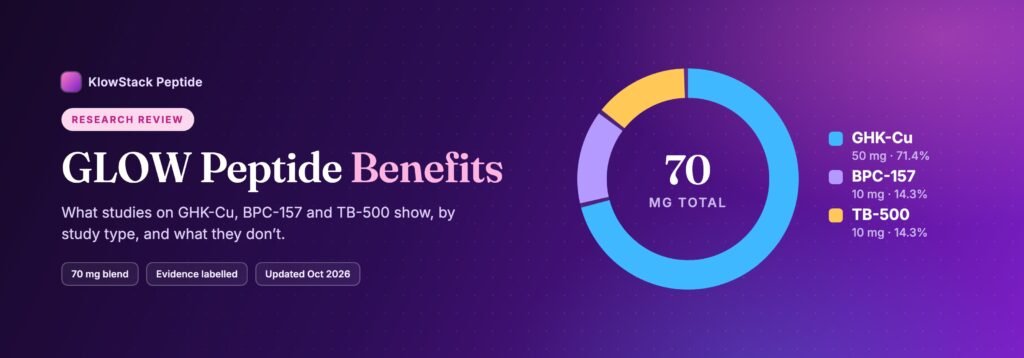
A standard GLOW vial holds 70 mg of freeze-dried peptide, mostly GHK-Cu at 50 mg, rounded out by BPC-157 and TB-500 at 10 mg apiece. GHK-Cu, the copper peptide, makes up about 71% of the weight. KLOW is the same formula with 10 mg of KPV added.
| Peptide | Amount | Share of 70 mg | Studied mainly for |
|---|---|---|---|
| GHK-Cu | 50 mg | 71.4% | Collagen, skin remodeling |
| BPC-157 | 10 mg | 14.3% | Tendon, gut and tissue injury models |
| TB-500 | 10 mg | 14.3% | Cell migration and wound models |
Recipes vary between sellers, so the batch lab report is what describes any single vial. The fourth ingredient in KLOW, KPV, brings inflammation-signaling research that GLOW lacks. Our KLOW vs GLOW comparison and the GLOW guide cover the formula in more depth.
GLOW Research at a Glance
Across GLOW’s three peptides, skin and collagen research is the only area with human data, and those studies tested GHK-Cu creams. Wound, tendon and tissue research is almost entirely animal or lab work. No study has tested GLOW itself in any model.
| Research area | GHK-Cu | BPC-157 | TB-500 |
|---|---|---|---|
| Skin and collagen | 🧪 Lab; 👤 small topical studies | 🐭 Animal (burn models) | 🐭 Animal (full Tβ4) |
| Wound models | 🐭 Animal | 🐭 Animal | 🐭 Animal; 👤 gel trials of full Tβ4 |
| Tissue and tendon models | None | 🐭 Animal; 🧪 lab | 🧪 Lab; 🐭 animal (mostly full Tβ4) |
| Inflammation signaling | 🧪 Lab | 🐭 Animal | 🐭 Animal (full Tβ4) |
| GLOW combination | None | None | None |
Read the bottom row first. Everything above it describes a single peptide in its own experiment, at its own concentration, often in a different species. The GLOW blend appears in no study at all.
GHK-Cu: Skin and Collagen Research
GHK-Cu is the most-studied GLOW ingredient for skin. Lab work shows skin fibroblasts making more collagen and elastin in its presence, small human studies tested GHK-Cu creams on skin for 8 to 12 weeks, and animal wound models link it to more collagen in new tissue.
Lab studies
🧪 In cultured human dermal fibroblasts, GHK-Cu at very low concentrations raised production of collagen and elastin, and earlier work reported more glycosaminoglycans and decorin, the molecules that hold water and organize collagen fibers. These findings are summarized in a 2018 review by Pickart and Margolina. In gene-database studies, GHK changed the activity of about 31% of human genes by half or more, a prediction from cell lines that hasn’t been tested in tissue. GHK-Cu also lowered secretion of IL-6, an inflammatory messenger, from fibroblasts stimulated in the lab.
Small human cosmetic studies
👤 The human GHK-Cu studies all used creams or serums applied to skin, which is a different thing from an injectable research blend. In a 12-week study of 71 women, a GHK-Cu facial cream was linked to greater skin density and reduced wrinkle depth. A thigh-skin study reported more collagen in 70% of participants using GHK-Cu cream, against 50% for vitamin C and 40% for retinoic acid. A 12-week eye-area study in 41 women compared it favorably with placebo and vitamin K creams, and an 8-week randomized, double-blind study of a GHK-Cu serum reported wrinkle volume 55.8% lower than with a control serum. The studies were small, and many came from researchers connected to the compound’s development.
A newer, independent view adds caution. An August 2026 evidence review in Pharmaceutics found preclinical data consistent but clinical data sparse, pointing to a 13-person laser-recovery study in which objective skin measures showed no advantage for GHK-Cu.
Wound-model research
🐭 Animal wound work on GHK goes back decades. In rats, a collagen dressing containing GHK raised wound collagen nine-fold, and in rabbits, GHK improved wound contraction and new tissue growth.
Our pages on GHK-Cu benefits and GHK-Cu skin research cover each study’s design.
BPC-157: Tissue and Injury-Model Research
BPC-157’s research comes mostly from rodent studies of tendon, ligament, gut and wound injury, much of it from one group in Croatia. Published human data are limited to three small uncontrolled studies with 30 people in total, none of them about skin or wounds.
🐭 The best-known BPC-157 work used rats with surgically cut Achilles tendons, reporting better strength and collagen organization in BPC-157 animals in a 2003 study by Staresinic and colleagues. Later rat studies covered ligaments, muscle and stomach lesions. On skin specifically, a mouse burn study in 2001 and a rat alkali-burn study in 2015 reported faster wound closure.
🧪 In rat tendon cells, BPC-157 increased outgrowth and migration, and in blood-vessel lining cells it activated VEGFR2, a receptor involved in new vessel formation, according to a 2017 study by Hsieh and colleagues.
👤 The three human reports are a 16-person look back at knee-pain patients, a 12-woman bladder study and a 2-volunteer infusion safety test, none with a placebo group and none about skin.
A 2025 systematic review in the HSS Journal counted 36 musculoskeletal studies, 35 of them preclinical. A September 2026 review in the International Journal of Molecular Sciences, focused on rodent injury models, called the evidence heterogeneous and described BPC-157 as a candidate for more animal research.
One more pattern deserves attention. Most BPC-157 papers come from a single research group at the University of Zagreb, and independent replication of its injury findings is limited, which is why reviewers describe the evidence as promising and preliminary at the same time. Our BPC-157 benefits page rates each research area.
TB-500: Repair and Cell-Migration Research
TB-500 is a 7-amino-acid fragment cut from thymosin beta-4 (Tβ4), the larger protein cells rely on to move. Most wound and repair research attributed to TB-500 actually tested full Tβ4, in animals and lab models. TB-500 itself has no published human trials.
The distinction is the main thing to know about this ingredient. TB-500 corresponds to a short active region of Tβ4, and chemists characterized the fragment sold under that name in a 2012 study in Drug Testing and Analysis. Research on the full protein doesn’t automatically transfer to the fragment.
🧪 Full Tβ4, lab: Tβ4 binds actin, the protein scaffolding cells rearrange in order to move, and supports cell migration into wounds.
🐭 Full Tβ4, animal: Malinda and colleagues reported in 1999 that Tβ4 sped wound closure in rats, and a 2004 study in Nature by Bock-Marquette and colleagues found Tβ4 helped heart muscle cells survive in mice after an induced heart attack. Both used the full protein, and the heart work is often quoted in TB-500 marketing without that detail.
👤 Full Tβ4, human: Phase 2 trials of a Tβ4 gel in venous stasis and pressure ulcers are listed as completed on ClinicalTrials.gov. Tβ4 eye drops have gone further, through several trials for dry eye, including one that enrolled about 700 people. Those are eye products using the full protein, a long way from an injectable research fragment.
A 2026 primer in the American Journal of Sports Medicine concluded that Tβ4 and TB-500 promoted tissue repair in preclinical models while human orthopedic data were lacking. Our TB-500 guide explains the fragment in detail.
Why Combine Them? The Rationale vs the Evidence
The argument for GLOW is that its three peptides act on different steps of tissue repair: collagen production, blood-vessel growth and cell movement. That’s a reasonable hypothesis. No study has tested the combination, so interactions, stability and the effect of the 50/10/10 ratio are all unknown.
Researchers also point to a practical logic. GHK-Cu’s research centers on the skin’s support structure, BPC-157’s on blood supply and tendon cells, and Tβ4’s on cell movement, so the three rarely overlap in what they were studied for. Whether non-overlapping research areas translate into complementary effects is exactly the untested part.
On paper, the pieces fit a familiar picture of wound repair. Cells migrate into damaged tissue, new vessels bring oxygen, and fibroblasts lay down collagen. GLOW’s ingredients were each studied for one of those steps.
What hasn’t been studied is long:
- whether the three peptides help, hinder or ignore each other
- how they behave stored together in one vial
- whether 50/10/10 is a meaningful ratio, or simply a convention
- whether any effect seen with one peptide survives in the mixture
A proper combination study would need each peptide alone, every pair, and all three together, which makes seven treatment groups plus a control, in the same model and at matched amounts. Nobody has run that design for GLOW. Our page on KLOW stack benefits covers the same question for the four-peptide version.
What People Report vs What Research Can Show
Online reports, clinic testimonials and before-and-after photos can’t show what GLOW does, because they have no comparison group, can’t account for placebo effects or natural change, and usually involve products of unknown purity. Only controlled studies can separate a compound’s effect from everything else going on.
Several things make personal reports unreliable as evidence:
- No comparison. Without a group that didn’t use the product, there’s no way to know what would have happened anyway.
- Expectation. People who expect a change tend to notice one, especially in something as subjective as how skin looks.
- Everything else changes too. Sleep, skincare, sun exposure, season and lighting all affect appearance, and photos are easy to stage, even unintentionally.
- Unknown contents. Without a verified batch report, nobody can say what was in a particular vial.
- Selective sharing. People with striking stories post them, and people with nothing to report rarely do.
- Timing. Many people try something new when a problem is at its worst, and problems at their worst usually ease on their own, which can make almost anything look like it helped.
Clinic testimonials add a further layer. Clinics that sell GLOW have an obvious reason to share their best stories, and they rarely report how many people noticed nothing. A collection of positive reports, however large, can’t reveal how common those outcomes are.
This page includes no photos, timelines or outcome claims for that reason.
Research Limitations
The main limits of GLOW research are that nobody has tested the blend, most findings come from animals or cells, the human data are small cosmetic studies of one ingredient in cream form, and product quality varies widely. Regulators haven’t approved GLOW or any of its ingredients.
- Small samples. Human GHK-Cu studies enrolled dozens of people at most.
- Species. Rodent results often fail to carry over to people.
- Short timelines. No study of any GLOW ingredient followed people for long periods, so long-term effects are unknown.
- Sport. BPC-157 and TB-500 are on the WADA Prohibited List, so the blend contains two banned substances.
- Concentration of research. Many GHK-Cu and BPC-157 studies come from small groups of researchers.
- Product quality. Research vials aren’t made under drug manufacturing rules. A verified certificate of analysis is the main check, as our guides to the KLOW COA and verifying a peptide COA explain.
- Regulatory status, as of October 15, 2026. None of GLOW’s ingredients is FDA-approved. All three left the FDA’s Category 2 compounding list in April 2026, according to the FDA’s compounding safety-risk page. FDA advisers recommended BPC-157 and TB-500 for the 503A Bulks List in July 2026, and GHK-Cu’s turn before the advisers is expected by late February 2027. See our guide on US peptide law.
FAQs
What is the GLOW peptide blend made of?
A standard GLOW vial contains 70 mg of freeze-dried powder made of three peptides, mostly GHK-Cu (50 mg), plus 10 mg of BPC-157 and 10 mg of TB-500. Some sellers use different amounts, so rely on the batch lab report for any single vial.
What does research on GHK-Cu, BPC-157 and TB-500 cover?
GHK-Cu research covers collagen and skin, including small human cream studies. BPC-157 research covers tendon, gut and wound injury, mostly in rats. TB-500 research mostly used its parent protein, thymosin beta-4, in wound and repair models.
Has the GLOW blend been studied in humans?
No. No published study has tested GLOW in people or animals. The only human data among its ingredients come from small topical GHK-Cu studies, three small BPC-157 reports, and gel trials that used full thymosin beta-4.
How is GLOW different from KLOW?
KLOW contains GLOW’s three peptides in the same amounts, plus 10 mg of KPV, a peptide studied for inflammatory signaling in cells and mice. That brings KLOW to 80 mg. See our KLOW vs GLOW comparison.
Is GLOW FDA-approved?
No. As of October 15, 2026, neither GLOW nor any of its three ingredients is FDA-approved, and none is on the FDA’s 503A Bulks List for compounding. GLOW is sold as a research-use-only product.
Conclusion
GLOW’s research story is three separate stories, one per peptide, with the strongest human chapter belonging to GHK-Cu creams. The blend itself hasn’t been written about yet, in any study.
Sources
- [Review: in vitro, animal, human topical] Pickart L, Margolina A. 2018. Regenerative and protective actions of the GHK-Cu peptide in the light of the new gene data. International Journal of Molecular Sciences. doi:10.3390/ijms19071987
- [Review] Mateescu DM, et al. 2026. GHK-Cu as a bioactive metallopeptide and drug-delivery cargo. Pharmaceutics. PubMed
- [Animal] Staresinic M, et al. 2003. Gastric pentadecapeptide BPC 157 accelerates healing of transected rat Achilles tendon and in vitro stimulates tendocytes growth. Journal of Orthopaedic Research. doi:10.1016/S0736-0266(03)00110-4
- [Review] Vasireddi N, et al. 2025. Emerging use of BPC-157 in orthopaedic sports medicine: a systematic review. HSS Journal. doi:10.1177/15563316251355551
- [Chemistry] Esposito S, et al. 2012. Synthesis and characterization of the N-terminal acetylated 17-23 fragment of thymosin beta 4 identified in TB-500. Drug Testing and Analysis. doi:10.1002/dta.1402
- [Animal] Malinda KM, et al. 1999. Thymosin beta4 accelerates wound healing. Journal of Investigative Dermatology. doi:10.1046/j.1523-1747.1999.00708.x
- [Review] 2026 primer on injectable peptides. American Journal of Sports Medicine. doi:10.1177/03635465251357593
- [Regulatory] Certain Bulk Drug Substances for Use in Compounding that May Present Significant Safety Risks, FDA, April 22, 2026