
Reviewed by Thomas Okafor, Peptide Chemist · Last updated October 14, 2026
KLOW has no FDA-approved source. It’s sold as a research-use-only chemical by peptide suppliers, and some clinics offer compounded versions whose legal footing is uncertain. The more useful question is how to check what’s actually inside a vial before anyone relies on it.
That’s what this page covers: the channels where KLOW shows up, what the prescription question really involves, the difference between a stack and a blend, eight checks for vetting a supplier, the red flags that should end the conversation, and what drives price. KLOW is sold for laboratory research use only and isn’t intended for human consumption. See our Medical Disclaimer.
Where Is KLOW Sold? The Main Channels
KLOW turns up in four places: research-chemical suppliers that sell it as a lab reagent, clinics and telehealth services offering compounded or “prescribed” versions, mainstream marketplaces where listings are usually something else, and forums or messaging apps, which carry the most risk.
Research-chemical suppliers
Most KLOW in the US comes from online peptide suppliers that label it for research use only. Buyers see two formats: four individual vials, or one vial with everything premixed. Quality varies enormously between these sellers, which is why the checks below exist.
Clinics and telehealth
Some clinics and telehealth services advertise prescribed or compounded KLOW. The usual route for a pharmacy to compound a bulk ingredient is the agency’s 503A Bulks List, and no KLOW ingredient had a place on it in mid-October 2026. Those offers fall into a regulatory gray area, covered in the next section.
Imports
Many research peptides ship from overseas. The FDA can detain imported products at the border when packaging or paperwork suggests they’re drugs meant for people, and a detained order typically leaves the buyer with no product and no refund from the seller.
Marketplaces and pharmacies
Searches for KLOW on Amazon or at CVS come up because people look there for everything. Retail pharmacies don’t stock research peptides, and products labeled “KLOW pills” or capsules on marketplaces aren’t the lyophilized research formula. Their contents are rarely documented by a verifiable lab report.
Forums and messaging apps
Private sellers on Telegram, Discord and forums are the highest-risk channel. There’s typically no business address, no verifiable testing and no recourse if a product is wrong.
Do You Need a Prescription for KLOW?
KLOW isn’t an FDA-approved drug, so there’s no prescription version in the usual sense. Research-use-only KLOW is sold for laboratory research, not for people. Clinics that advertise a prescription version depend on compounding, a pathway still closed to all four ingredients.
The status of each ingredient moved in 2026:
- April 2026: Nominators withdrew all four ingredients, which ended their Category 2 listings (for GHK-Cu, the listing concerned injectable use). The record is on the FDA’s compounding risk page.
- July 23, 2026: An outside panel told the FDA it favored listing BPC-157, TB-500 and KPV. Advice of this kind binds nobody. See our coverage of the vote.
- Early October 2026: A Washington Post story described a draft plan to let some pharmacies sell certain peptides before final rules. Nothing has been announced. See our news report on the stopgap plan.
Our KLOW legal status page and US peptide law guide go further.
Stack or Blend: What You’re Actually Buying
A KLOW stack is four separate vials, each with its own lab report. A KLOW blend is one premixed vial, with one report that has to cover all four peptides. Sellers don’t all use the same recipe, so compare the label’s numbers with the lab report’s.
The format also changes what a buyer can check on arrival. Four vials should arrive with four lot numbers and four reports, one per compound. A blend should arrive with one lot number and one report listing all four peptides. A mismatch between what arrived and what the paperwork describes is the first sign something is off.
Single-peptide reports are simpler to read and easier for labs to get right. A blend report has to resolve four peptides in one run, two of them nearly identical in mass, and quantify each. The common formula combines 50 mg of GHK-Cu and a 10 mg share each of the other three, though listings exist with half that copper-peptide amount. Our upcoming comparison of KLOW versus the four peptides bought separately covers the trade-offs in detail.
How to Vet a KLOW Supplier: 8 Checks
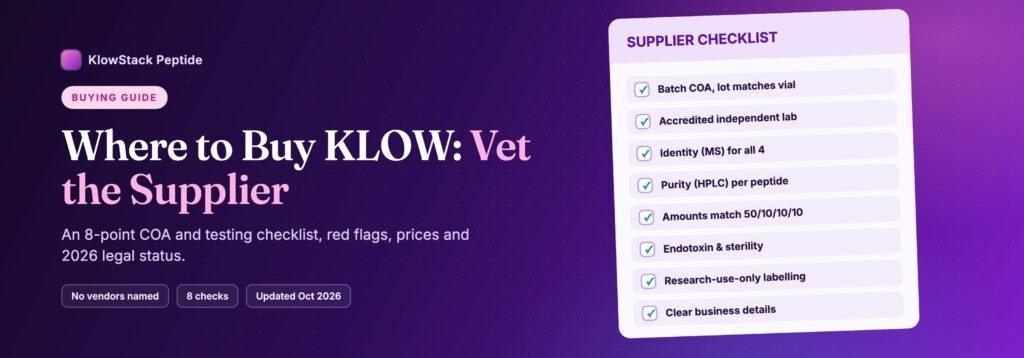
The eight checks are a batch-specific COA matching your lot, an accredited independent lab you can confirm directly, identity testing for each peptide, purity per peptide, amounts that match the label, safety testing for contaminants, research-only marketing, and clear business details.
1. A batch-specific COA that matches your vial
The certificate of analysis should carry the same lot number as the vial in hand. A generic “sample” report from some earlier batch describes that batch, not this one.
2. An accredited, independent lab you can confirm yourself
The lab shouldn’t belong to the seller, and accreditation under ISO/IEC 17025, the benchmark for testing-lab competence, is a strong sign. Reach the lab through a website or phone number you looked up independently, give it the report number, and ask whether its records show the same compounds, amounts and test date. Many labs now print a verification code or QR link, though a code that leads back to the seller’s own site proves nothing.
3. Identity by mass spectrometry for all four peptides
Mass spectrometry should report a measured molecular weight for GHK, KPV, BPC-157 and TB-500, each next to its theoretical value. A blend report missing one of the four hasn’t confirmed what’s in the vial.
4. Purity for each peptide
Ask for purity by HPLC for each peptide separately. One blended “99%” can look excellent while an ingredient is short or missing.
5. Amounts that match the label
Each peptide’s measured milligrams should land close to the label, 50/10/10/10 in the standard formula, or whatever ratio that vial claims.
6. Endotoxin, sterility and heavy metals
Endotoxins, pieces left behind by bacteria, slip straight past a purity test. Sterility testing checks for living microbes. Heavy-metal testing should show copper, expected from GHK-Cu, without lead, arsenic, mercury or cadmium. Many reports skip these, so ask.
7. Research-only labeling with no human-use marketing
In warning letters dated August 24, 2026, the FDA told five online peptide sellers that dosing guides, injection instructions, reconstitution calculators and bacteriostatic water sold alongside peptides showed their products were meant for human use, despite “research use only” labels. In practice, a compliant product page reads like a chemical catalog: compound name, amount, purity, lot number and lab report, with nothing about how a person would use it. Our report on the warning letters covers what the agency cited.
8. Clear business details
A real address, working contact information, batch records you can request, and a written process for handling complaints and wrong orders.
Our KLOW COA guide and peptide COA verification guide explain checks 1 to 6 step by step.
Red Flags to Walk Away From
The clearest red flags are a missing or generic COA, a lab you can’t find, dosing guides or before-and-after photos, “FDA approved” claims, KLOW sold as pills, marketplace listings, prices far below the usual range, crypto-only payment, and pressure tactics through messaging apps.
- No COA, a generic COA, or a lab that doesn’t exist. In July 2026, the owner of one peptide company was sentenced to 70 months in federal prison in a case involving forged certificates of analysis, according to legal analysis of FDA enforcement.
- Dosing or injection guides, “results” claims, or before-and-after photos. These are the human-use signals the FDA’s warning letters focused on.
- “FDA approved.” The FDA has approved no KLOW product and none of its ingredients.
- “KLOW pills” or capsules. These don’t match the research formula, and their contents are rarely documented.
- Marketplace listings. Mainstream marketplaces aren’t where documented research reagents are sold.
- Prices far below the usual range. Independent testing costs money, and rock-bottom prices often mean little of it was done.
- Crypto-only payment. Blockchain analytics firm Chainalysis estimated crypto payments to gray-market peptide vendors reached about $32 million in the first quarter of 2026, as card processors turned the trade away, The Block reported.
- One report for every product. The same chromatogram or report number appearing for different peptides or batches means the document describes none of them.
- Claims of clinic or physician endorsement. State boards are tightening rules. Alabama’s medical board said in June 2026 that physicians may not compound, administer or dispense non-approved or research-grade peptides, according to legal analysis of 2026 enforcement.
- Pressure tactics and Telegram-only sales. Countdown timers, “last batch” claims and no way to reach anyone afterward.
KLOW Stack Price: What Affects the Cost
In fall 2026, US-facing listings for a premixed 80 mg KLOW vial generally ran from under $100 to around $200, while four-vial stack kits ran roughly $290 to $400 or more. Testing quality, format and seller overhead explain most of the spread.
Several factors shape a price:
- Format. Each vial in a stack needs its own fill, label and lab report, so kits run higher than a single premixed vial.
- Composition. The copper peptide is both the cheapest per milligram and the heaviest component, which holds a blend’s average near $1.10 to $2.25 per mg.
- Testing. A seller paying for lot-specific, four-peptide identity testing plus endotoxin screening has higher costs than one posting an old report.
- Ratio. Versions with less GHK-Cu, or different totals, aren’t directly comparable.
- Shipping and customs. International orders can add shipping costs and customs risk, and a detained parcel is a total loss.
Prices were checked against public listings in September and October 2026 and change often.
A quick comparison shows how much the format moves the number. A premixed vial at $135 works out to about $1.69 per milligram of powder. A four-vial kit at $340 holding the same 80 mg comes to about $4.25 per milligram. The second option costs more mainly because it buys four separate lab reports and independent control of each amount.
Why “Best Place to Buy” Lists Are Usually Paid Placements
Ranked “best place to buy KLOW” lists, especially on unrelated medical-sounding websites, are usually paid placements that send readers to one seller. They rarely disclose that relationship, and the top-ranked seller often turns out to be the sponsor.
A federal rule now covers part of this. The FTC’s ban on fake reviews and testimonials, in force since late 2024, lets the agency seek penalties when a business passes off a site it controls as an independent reviewer. That rule doesn’t make every ranked list trustworthy, so read any “top 5” with its source in mind. A few signs give paid lists away:
- The site has nothing to do with peptides, such as a medical specialty or local news domain.
- One seller wins every category and gets a discount code.
- The page never mentions COAs, labs or batch testing.
- No author, date or disclosure appears anywhere. Our page on KLOW stack reviews explains how to judge them.
What Buying Doesn’t Change: Evidence and Safety
A well-tested vial confirms what’s inside it. It doesn’t change what’s known about KLOW, which is that the four-peptide formula has never been studied, and each ingredient’s research comes mostly from cells and animals.
Testing also says nothing about how a vial was stored or shipped after the lab report was issued, since a report describes the sample on its test date.
Purity and identity testing answer one question: is this the right material at the stated amount? Whether the material does anything in people, or what its risks are, is a separate question that only clinical research can answer. Our pages on KLOW stack benefits and KLOW side effects sort the research by study type.
FAQs
Where can I buy KLOW?
Online research-chemical suppliers sell KLOW as a lab reagent, in four-vial or premixed form. We don’t recommend sellers. Use the eight checks above, starting with a lot-matched COA you can confirm with an independent lab.
Is KLOW sold on Amazon or at CVS?
Retail pharmacies don’t stock research peptides, and KLOW isn’t an approved drug. Listings on mainstream marketplaces are usually capsules or supplements using the name, without lab documentation that matches the research formula.
Do you need a prescription?
There’s no FDA-approved KLOW to prescribe. Research-use-only KLOW is a lab reagent. Prescription offers depend on pharmacy compounding, which none of the four ingredients qualified for in mid-October 2026.
What kind of peptide is KLOW?
KLOW is a research formula combining four peptides: GHK-Cu, a copper-binding tripeptide; BPC-157, a gastric-derived peptide; TB-500, a fragment of thymosin beta-4; and KPV, an alpha-MSH fragment. The standard version holds 80 mg in total.
KLOW or GLOW: what’s the difference?
GLOW stops at three ingredients (the copper peptide, BPC-157 and TB-500). KLOW includes KPV as well, an inflammation-signaling peptide, for 80 mg in total. Our KLOW vs GLOW comparison covers the details.
How much does KLOW cost?
Premixed 80 mg vials generally ran from under $100 to around $200 in US-facing listings in fall 2026, with four-vial kits higher. Very low prices usually mean less testing, not a better deal.
How do I check a KLOW COA?
Start with the batch code, then verify the lab on your own, then look for separate identity and quantity results for all four peptides and an endotoxin result. Our KLOW COA guide walks through it.
Conclusion
There’s no approved place to buy KLOW, only sellers that are easier or harder to verify. Treat every vial as unconfirmed until its lab report checks out with the lab itself.
Sources
- [Regulatory] Certain Bulk Drug Substances for Use in Compounding that May Present Significant Safety Risks, FDA, April 22, 2026
- [Regulatory] Warning Letter to Gram Peptides, FDA, March 31, 2026
- [Legal analysis] Client alert on FDA peptide enforcement, McDermott Will & Schulte, September 24, 2026
- [Regulatory] Federal Trade Commission Announces Final Rule Banning Fake Reviews and Testimonials, FTC, August 14, 2024
- [Standard] ISO/IEC 17025: General requirements for the competence of testing and calibration laboratories, ISO
- [News] Chainalysis says top-tier gray market peptide vendors turn to bitcoin and stablecoins, The Block, June 4, 2026
- [News] Trump administration paving way for temporary sale of some unapproved peptides, The Washington Post, October 7, 2026