
Reviewed by Thomas Okafor, Peptide Chemist · Updated October 2026
The KLOW stack is a set of four research peptides, GHK-Cu (50 mg), KPV (10 mg), BPC-157 (10 mg) and TB-500 (10 mg), sold as separate vials in one bundle. When the same four come premixed in a single 80 mg vial, it’s called the KLOW blend. Either way, it’s the three-peptide GLOW formula with KPV added. Each ingredient has its own cell and animal research, but there are no human trials of KLOW in either form.
If you’ve seen KLOW pop up on a med spa menu or in a recovery video and wondered what’s actually in it, you’re in good company. Below, we walk through each of the four peptides, what scientists have tested them for, and what the FDA’s July 2026 advisory vote means. By the end, you’ll know what questions to ask before believing any claim about it. Our peptide blends hub covers the wider family of mixes.
This guide is educational and isn’t medical advice. KLOW is sold for research use only; see our Medical Disclaimer.
Where Does the Name KLOW Come From?
KLOW isn’t a brand or an acronym. It’s the GLOW blend (GHK-Cu, BPC-157, TB-500) with KPV added, so the “K” stands for KPV. No company owns the name, so each supplier makes its own version, and the label, the purity and even the stated ratio can differ from one vial to the next.
Think of KLOW less like a product and more like a recipe that got passed around. Premixed in one vial, it goes by the KLOW blend, KLOW peptide or KLOW 80, after the vial size. Sold as four separate vials in one bundle, it’s the KLOW stack. Both carry the same four peptides in the same ratio. What is KLOW from one seller to the next? Ideally the same thing, which is why every batch needs its own testing.
You’ll usually run into it in one of three places:
- Research suppliers: freeze-dried powder in sealed vials, labeled for research.
- US clinics and med spas: compounded injections and under-the-tongue drops, often sold as monthly programs.
- Social media and forums: recovery stories, before-and-after posts and long threads arguing about the ratio.
The thinking behind the KLOW peptide blend is easy to follow. Each peptide has been studied for a different piece of the healing process, so using all four together might cover more ground. It’s a hypothesis, and a reasonable one, that the science hasn’t yet tested as a combination.
What’s in the KLOW Stack? (The 50/10/10/10 Ratio)
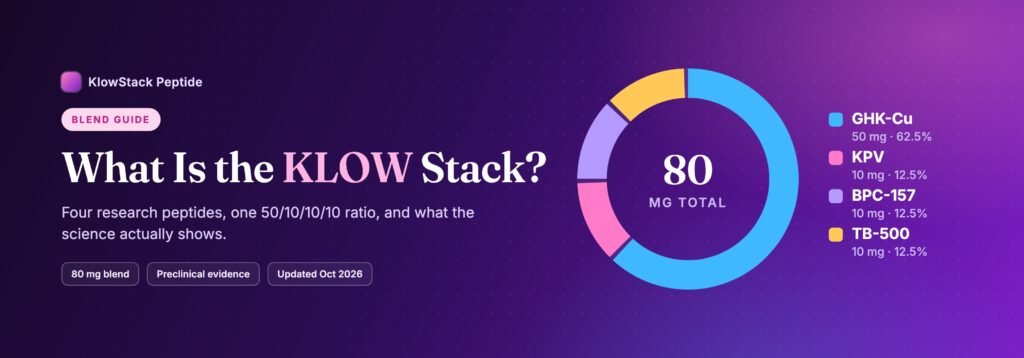
Whether it comes as a stack or a blend, standard KLOW holds 80 mg of peptide in a 5:1:1:1 ratio: 50 mg GHK-Cu (62.5%), plus 10 mg each of KPV, BPC-157 and TB-500 (12.5% each). GHK-Cu makes up most of the total by weight, which is why sellers so often market KLOW for skin and hair.
| Peptide | Amount (mg) | % of total | What it is | Main research focus |
|---|---|---|---|---|
| GHK-Cu | 50 mg | 62.5% | Copper-bound tripeptide (glycine-histidine-lysine) | Collagen, skin remodeling, wound healing |
| KPV | 10 mg | 12.5% | Tripeptide (lysine-proline-valine) from alpha-MSH | Inflammation, gut lining |
| BPC-157 | 10 mg | 12.5% | 15-amino-acid synthetic peptide | Tendon repair, blood-vessel growth, gut lining |
| TB-500 | 10 mg | 12.5% | Synthetic peptide based on thymosin beta-4 | Cell migration, wound closure |
| Total | 80 mg | 100% | Four peptides | Tissue repair (preclinical) |
So KLOW is mostly GHK-Cu, the way a bag of trail mix is mostly peanuts. The other three are there in equal, smaller amounts. Every milligram in that table is dry peptide powder. In the KLOW blend, once it’s sealed in one vial, the proportions are locked in place. In the KLOW stack, each peptide stays in its own vial.
Why Does GHK-Cu Make Up 62.5% of KLOW?
No published study explains why the blend is weighted this way. The 5:1:1:1 pattern carries over from GLOW, which holds 50 mg GHK-Cu with 10 mg each of BPC-157 and TB-500, for 70 mg in total. KLOW keeps that recipe and adds 10 mg of KPV on top.
GHK-Cu is also the ingredient behind most of the skin and hair interest, so a generous share of it fits how people use the word “glow” in the first place.
Here’s a small warning sign: online sources don’t agree on the numbers. One ranking page lists BPC-157 as the 62.5% ingredient, and a KLOW information site says the ratio isn’t disclosed at all. Only a certificate of analysis that measures each peptide separately can tell you what’s in a given vial.
Why Does KLOW Turn Blue?
KLOW is blue because GHK-Cu is a copper(II) complex, and copper(II) compounds look blue in water. If you remember the bright blue copper sulfate crystals from high school chemistry, it’s the same idea. The color tells you copper is there. It can’t tell you the purity, the GHK-Cu amount, or whether the other three peptides made it in.
What Does Each Peptide in KLOW Do?
Each of KLOW’s four peptides is studied for a different part of tissue repair: GHK-Cu for collagen and skin remodeling, KPV for inflammation, BPC-157 for blood-vessel growth and tendon repair, and TB-500 for cell migration. Almost all of the research behind the KLOW peptide blend’s ingredients comes from cells and animals.
GHK-Cu (50 mg), the Copper Peptide
Evidence: clinical studies for topical skin use; preclinical for everything else.
GHK-Cu is a tiny peptide, just three amino acids (glycine, histidine and lysine), holding onto a copper ion. Your own body makes it, and it turns up in your blood, saliva and urine.
Here’s the detail that got skincare researchers excited. A 2015 review by Pickart and colleagues reports plasma GHK falling from about 200 ng/mL at age 20 to about 80 ng/mL by age 60. That age-related drop is a big reason GHK-Cu became a focus of skin-aging research.
The best human evidence comes from creams and serums, where small studies found firmer, denser skin and softer wrinkles. In the lab, GHK can turn thousands of genes up or down, many of them tied to repair. What it does as an injection is mostly known from rodent wound studies and cells in a dish.
Loren Pickart, the researcher who first isolated GHK, has spent decades studying it. In a 2018 review with Anna Margolina, the pair wrote that its known actions “appear to be health positive,” pointing to repair effects in skin, lung tissue, bone, liver and stomach lining across lab and animal models.
Our GHK-Cu guide covers serums, injectables and the full evidence base.
KPV (10 mg), the Ingredient That Makes It KLOW
Evidence: preclinical.
KPV is another three-amino-acid peptide (lysine, proline and valine), clipped from the end of a hormone called alpha-MSH. Alpha-MSH does two jobs in the body: it helps tan your skin, and it calms inflammation. KPV keeps the calming job and skips the tanning one.
The paper most people cite came out of Emory University in 2008. Writing in Gastroenterology, Dalmasso and colleagues showed that gut cells pull KPV inside through a doorway called PepT1. Tiny amounts dialed down a major inflammation switch (NF-kappaB) in human intestinal cells. When mice drank KPV in their water, two different types of colitis were milder.
That’s where KLOW’s reputation as “GLOW plus an anti-inflammatory” comes from, and it’s a fair summary of what the mouse work suggests. KPV is the youngest of the four in terms of public interest, so its research library is smaller, and people studies haven’t been published yet.
The KPV guide goes through the colitis, skin and wound studies one by one.
BPC-157 (10 mg), the Repair Peptide
Evidence: preclinical, with very limited human data.
BPC-157 is a 15-amino-acid synthetic peptide modeled on a protein found in human stomach juice. BPC stands for “body protection compound,” a name that says a lot about the hopes attached to it. Much of the research comes from one team at the University of Zagreb in Croatia, led by Predrag Sikirić, working mostly with rats.
Its claim to fame is tendons, the tough cords that tie muscle to bone. In a 2011 Journal of Applied Physiology study, Chang and colleagues found that BPC-157 helped rat Achilles tendon cells grow out and move faster, and the effect got stronger with higher amounts.
A 2018 review led by Sven Seiwerth connects many of BPC-157’s effects to new blood-vessel growth, which brings oxygen and nutrients to an injury. The animal findings are plentiful and point in the same direction. Controlled trials in people are the missing chapter, and WADA bans it in sport.
Our BPC-157 guide walks through the full research record, including the few human reports.
TB-500 (10 mg), the Cell-Migration Peptide
Evidence: preclinical.
TB-500 is based on thymosin beta-4 (Tβ4), a 43-amino-acid protein that manages actin, the scaffolding cells use to crawl toward a wound. Most TB-500 for sale is a short fragment built around the part of Tβ4 that grabs actin, though the exact sequence varies by supplier.
The parent protein has a deep animal record. Malinda and colleagues found in 1999 that it helped wounds close faster in rats. In 2004, Bock-Marquette and colleagues reported in Nature that Tβ4 helped heart cells survive a heart attack in mice and improved how well the hearts pumped.
Allan Goldstein, the George Washington University biochemist who co-discovered the thymosins, has championed this protein for years. His 2012 review describes Tβ4 as a multi-functional regenerative peptide with potential in skin, eye, heart and brain repair.
One detail trips a lot of people up. The human eye-drop trials you may read about used full-length thymosin beta-4, which is a different molecule from the TB-500 fragment, and sellers rarely say which one is in the vial. TB-500 is also banned in sport. The TB-500 guide explains the difference.
Why Are These Four Peptides Combined?
KLOW combines four peptides because each is studied for a different stage of repair, so together they might cover more ground than any one alone. That logic comes from separate studies of each peptide. The combination itself has never been tested in a published study.
Picture a road crew fixing a pothole. Someone sets up the cones, trucks bring in material, workers show up, and the asphalt goes down. KLOW’s four peptides map onto that same order:
- Inflammation (KPV): calming the area, like setting up the cones.
- Blood supply (BPC-157): bringing in supplies through new blood vessels.
- Cell movement (TB-500): getting repair cells to the job site.
- Rebuilding (GHK-Cu): laying down fresh collagen.
It’s a neat model. The catch is in the details. The amounts used and routes in the original studies don’t match a blended vial: mice drank KPV, rats got BPC-157 by injection or in their water, and GHK-Cu’s best results are from skin creams. Whether the four help each other, get in each other’s way, or work best at 5:1:1:1 is still unknown.
A fantasy football lineup can look unbeatable on paper and still lose on Sunday. Biology works the same way, which is why combination medicines need their own trials.
The convenience of the KLOW blend is real, though. One premixed vial is easier to buy and store, at the cost of adjusting any single peptide, which the separate vials of a KLOW stack allow. Our comparison of KLOW vs buying the 4 peptides separately lays out both options.
KLOW vs GLOW vs Wolverine: What’s the Difference?
KLOW contains four peptides, GLOW three and Wolverine two. GLOW is KLOW without KPV, and Wolverine is BPC-157 and TB-500 on their own. None of the three blends has been tested in a human trial, so choosing between them comes down to which ingredients’ research areas interest you.
| KLOW | GLOW | Wolverine | |
|---|---|---|---|
| GHK-Cu | 50 mg | 50 mg | None |
| KPV | 10 mg | None | None |
| BPC-157 | 10 mg | 10 mg | Usually 10 mg |
| TB-500 | 10 mg | 10 mg | Usually 10 mg |
| Typical vial | 80 mg | 70 mg | Varies (often 20 mg) |
| Marketed for | Skin, repair, inflammation, gut | Skin, hair, repair | Tendon, ligament and injury recovery |
| Human trials of the blend | None | None | None |
If KPV’s research area isn’t relevant to you, KLOW and GLOW are otherwise identical.
The names give away how each blend is pitched. GLOW points to the skin glow copper peptides are known for. Wolverine is named after the Marvel character who heals from almost anything, so it’s aimed at gym injuries and cranky tendons. KLOW adds KPV’s inflammation story on top of GLOW. All three share the same BPC-157 and TB-500 core.
For a closer look, our KLOW vs GLOW page compares the two copper blends, and KLOW vs GLOW vs Wolverine adds the two-peptide option.
What Does the Research on KLOW Actually Show?
There is real research behind each KLOW ingredient, almost none of it in people, and none on the four-peptide blend. Topical GHK-Cu has small human studies. KPV, BPC-157 and TB-500 rest mainly on cell and animal work, and that body of work keeps growing year after year.
What the evidence supports
- Topical GHK-Cu: small human studies of creams and serums reporting better skin density, firmness and fine lines.
- Animal repair and anti-inflammatory data: KPV in mouse colitis, BPC-157 in rat tendon and gut models, and thymosin beta-4 in rat wounds and mouse hearts.
- Human eye-drop trials of full-length thymosin beta-4: studied for corneal wounds and dry eye, as summarized in Goldstein’s 2012 review.
What it doesn’t support
- Healing or anti-aging results in people from injected or under-the-tongue KLOW.
- “Synergy,” meaning the four working better together than apart.
- Any benefit tied to the 5:1:1:1 ratio itself.
About the before-and-after stories
The recovery stories online come from real people, and many of them are sincere. The tricky part is that bodies heal on their own. A sprained ankle usually feels better in two or three weeks whether you ice it, tape it or binge a Netflix series on the couch. Without a comparison group, nobody can tell how much of a recovery came from the vial.
That’s why we treat those posts as user reports. They’re great for spotting what’s worth studying next. Our KLOW benefits page sorts every claimed benefit by its evidence level, from lab dish to human trial.
Is KLOW worth it? From a research point of view, the most solid knowledge today comes from the separate ingredient studies above. What the blend does in people is a question only future human trials can answer.
What Are the Side Effects of KLOW?
KLOW’s side effects in humans are unknown because the blend has never been studied in people. The known risks come from product quality, the untested stability of the mix, and the lack of human safety data for each ingredient. What you read online about how people feel on it comes from personal reports.
Here’s where the risk comes from:
- Product quality: too little peptide, the wrong peptide, bacterial toxins (endotoxins) or leftover solvents. Four peptides, whether in one vial or four, means four chances for a mistake.
- Stability: nobody has published data on whether GHK-Cu’s copper affects the other three peptides once the powder is mixed with water. Copper can bind to some amino acids, so it’s a fair question.
- Theoretical concern: BPC-157 and TB-500 are studied for growth signals, such as new blood vessels and moving cells. In tissue where growth isn’t wanted, like an existing tumor, that could be a problem. This remains a theory.
- Reported reactions: online self-reports mention skin redness, nausea, tiredness or headaches. None of these has been measured in a study.
Anyone who is pregnant, has a cancer history, competes in tested sports, is under 18, or has a copper condition such as Wilson’s disease has extra reasons for caution. A licensed clinician is the right first conversation. Our KLOW side effects page covers each risk in more depth.
Is the KLOW Stack Legal in the US? (2026 Update)
KLOW isn’t FDA-approved in either form, stack or blend, and is sold as “research use only.” As of October 2026, none of its four peptides is on the FDA’s 503A compounding list, although an FDA advisory panel voted in July 2026 to recommend three of them: BPC-157, KPV and TB-500. GHK-Cu wasn’t part of that review.
| Date | What happened | What it means |
|---|---|---|
| July 23, 2026 | The FDA’s Pharmacy Compounding Advisory Committee votes 8-6, with 1 abstention, for BPC-157, KPV and TB-500 | Advisory only. The FDA must accept it and finish rulemaking. |
| July 2026 | GHK-Cu isn’t on the meeting agenda | No change for GHK-Cu |
| April 2026 | The FDA removes BPC-157 and TB-500 from its Category 2 safety list | A step toward review, which is different from approval |
What does a 503A list mean for you? It’s the list of ingredients that licensed compounding pharmacies may use to make custom prescriptions. Getting on it would let a doctor prescribe a compounded version through a pharmacy.
AJMC reported that the panel backed six peptides across its two meeting days. Scott Brunner, CEO of the Alliance for Pharmacy Compounding, told the outlet that the FDA still has to formally adopt the recommendations before pharmacies can legally compound them. That takes a proposed rule, a public comment period and a final rule, a process that usually runs for months.
Until then, compounded clinic injections of KLOW are in a legal grey area. New Drug Loft, a compounding pharmacy, keeps a running log of the changes. Our guide to whether research peptides are legal explains the wider rules.
Athletes: BPC-157 is banned under the WADA Prohibited List class S0 (non-approved substances). Thymosin beta-4 derivatives, including TB-500, are banned under S2. Both are banned at all times, and USADA has warned athletes about BPC-157 directly. FDA and WADA status checked October 5, 2026.
How Much Does KLOW Cost, and How Do You Check a COA?
In US research-supply listings, an 80 mg KLOW blend vial cost about $90 to $180 as of October 2026. Because it’s a four-peptide blend, a trustworthy certificate of analysis (COA) tests each peptide separately and reports four sets of results. One overall purity number can’t show you whether every ingredient made it into the vial.
Price usually tracks three things: how much testing the seller pays for, a blend versus a stack, and any clinic visit bundled into the price. You’ll see KLOW sold three ways:
- A single 80 mg KLOW blend vial
- A KLOW stack: four separate vials, one per peptide, sold as a bundle
- Clinic injections or under-the-tongue programs, priced by the month
You won’t find a dose here. The dosing charts floating around online were written by vendors and forum regulars, and no clinical study of the blend stands behind them. KlowStack doesn’t publish human dosing for any research compound.
Think of a COA as the vial’s Carfax report. A good one covers these five things:
☐ Identity of all 4 peptides, confirmed by HPLC plus mass spectrometry
☐ Purity for each peptide
☐ Measured mg for each peptide against the label
☐ Endotoxin and sterility results
☐ Lot number, test date and an independent lab you can contact
A COA that only says “KLOW 80 mg, purity 99%” leaves the first three boxes empty, however good that number looks. It’s also worth matching the lot number on the report to the one printed on your vial.
Our KLOW COA guide shows what a strong four-peptide report looks like, and the guide on how to verify a peptide COA works for any single compound.
Frequently Asked Questions
What is a KLOW peptide stack?
A KLOW peptide stack is the four KLOW peptides sold as separate vials in one bundle: 50 mg GHK-Cu plus 10 mg each of KPV, BPC-157 and TB-500. The same four premixed in one 80 mg vial is the KLOW blend. Both are the GLOW formula with KPV added, sold as freeze-dried powder.
What does KLOW stand for?
KLOW isn’t an acronym. The name comes from GLOW, the older three-peptide blend, with the “G” swapped for a “K” to mark the added KPV. No company owns the name or the formula.
What does the KLOW blend do?
Each KLOW peptide is studied for a different repair job: calming inflammation, building blood supply, moving cells and rebuilding collagen. Those findings come from cell and animal studies. The blend’s effects in people haven’t been tested.
What’s better, KLOW or GLOW?
Neither has human trials, so there’s no proven winner. The only difference is 10 mg of KPV, studied for inflammation and gut health. Our full KLOW vs GLOW comparison breaks it down.
How long does it take for KLOW to work?
There’s no evidence-based timeline, because no human study has measured one. Online claims range from days to months. They come from personal stories and vendor marketing, which can’t separate the blend from natural healing.
How long do people stay on KLOW?
No trial has tested a KLOW cycle length. The cycles you’ll see online, often several weeks, come from vendors and forum posts. KlowStack doesn’t publish protocols for unapproved compounds.
Is KLOW worth it?
It depends on what you want to learn. Each ingredient has promising early research, mostly in animals. Product quality, legal status and the missing human data on the blend are all worth weighing first.
Is KLOW safe?
KLOW’s safety in humans is unknown, since the blend hasn’t been tested in people. The main known risks are product quality, contamination, how stable the mixed peptides are, and limited safety data on each ingredient.
Is KLOW FDA-approved?
No. KLOW isn’t FDA-approved, and none of its peptides is on the FDA’s 503A compounding list as of October 2026. A July 2026 advisory vote recommended three ingredients, but that vote isn’t binding.
How much does KLOW cost?
An 80 mg KLOW blend vial cost about $90 to $180 in US research-supply listings in October 2026. Clinic programs cost more. A rock-bottom price often means less testing, so check the COA first.
Does KLOW need to be refrigerated?
Freeze-dried KLOW powder is usually kept cold, dry and out of the light. Follow the storage notes on the supplier’s label and COA, and see our peptide storage guide for general handling tips.
Why is KLOW blue?
KLOW is blue because of the copper in GHK-Cu, its biggest ingredient. Copper(II) compounds look blue in water. The color confirms copper is there and says nothing about purity or the other three peptides.
Sources
Studies
- Pickart L, Margolina A. 2018. Regenerative and Protective Actions of the GHK-Cu Peptide in the Light of the New Gene Data. International Journal of Molecular Sciences. doi:10.3390/ijms19071987
- Pickart L, Vasquez-Soltero JM, Margolina A. 2015. GHK Peptide as a Natural Modulator of Multiple Cellular Pathways in Skin Regeneration. BioMed Research International. doi:10.1155/2015/648108
- Dalmasso G, et al. 2008. PepT1-Mediated Tripeptide KPV Uptake Reduces Intestinal Inflammation. Gastroenterology. doi:10.1053/j.gastro.2007.10.026
- Chang CH, et al. 2011. The promoting effect of pentadecapeptide BPC 157 on tendon healing involves tendon outgrowth, cell survival, and cell migration. Journal of Applied Physiology. doi:10.1152/japplphysiol.00945.2010
- Seiwerth S, et al. 2018. BPC 157 and Standard Angiogenic Growth Factors. Current Pharmaceutical Design. doi:10.2174/1381612824666180712110447
- Malinda KM, et al. 1999. Thymosin β4 Accelerates Wound Healing. Journal of Investigative Dermatology. doi:10.1046/j.1523-1747.1999.00708.x
- Bock-Marquette I, et al. 2004. Thymosin β4 activates integrin-linked kinase and promotes cardiac cell migration, survival and cardiac repair. Nature. doi:10.1038/nature03000
- Goldstein AL, et al. 2012. Thymosin β4: a multi-functional regenerative peptide. Expert Opinion on Biological Therapy. doi:10.1517/14712598.2012.634793
Regulatory and news
- FDA: July 23-24, 2026 Meeting of the Pharmacy Compounding Advisory Committee
- AJMC: FDA Panel Backs 6 Peptides for Compounding
- New Drug Loft: Regulatory Updates on Compounded Peptides
- USADA: BPC-157, Experimental Peptide Creates Risk for Athletes
- WADA Prohibited List
Composition reference: my-peptides.co.uk KLOW guide
Disclaimer: KLOW and its ingredients are sold for research use only and aren’t approved for human use. This guide is educational and isn’t medical advice. Read our Medical Disclaimer and Editorial Policy to see how we source and review every claim.